
| Rules | • | Spyragia Setting | • | Monsters | • | Stories |
| Table of Contents |
| Welcome |
| Summary Tables with Links |
| The Nine Powers
• Yarnspinner • Laurel • Soot Erica • Speleoth • Little Humble • Gnash • Maw Lute • Futhorc • Iceforge |
| Colonies
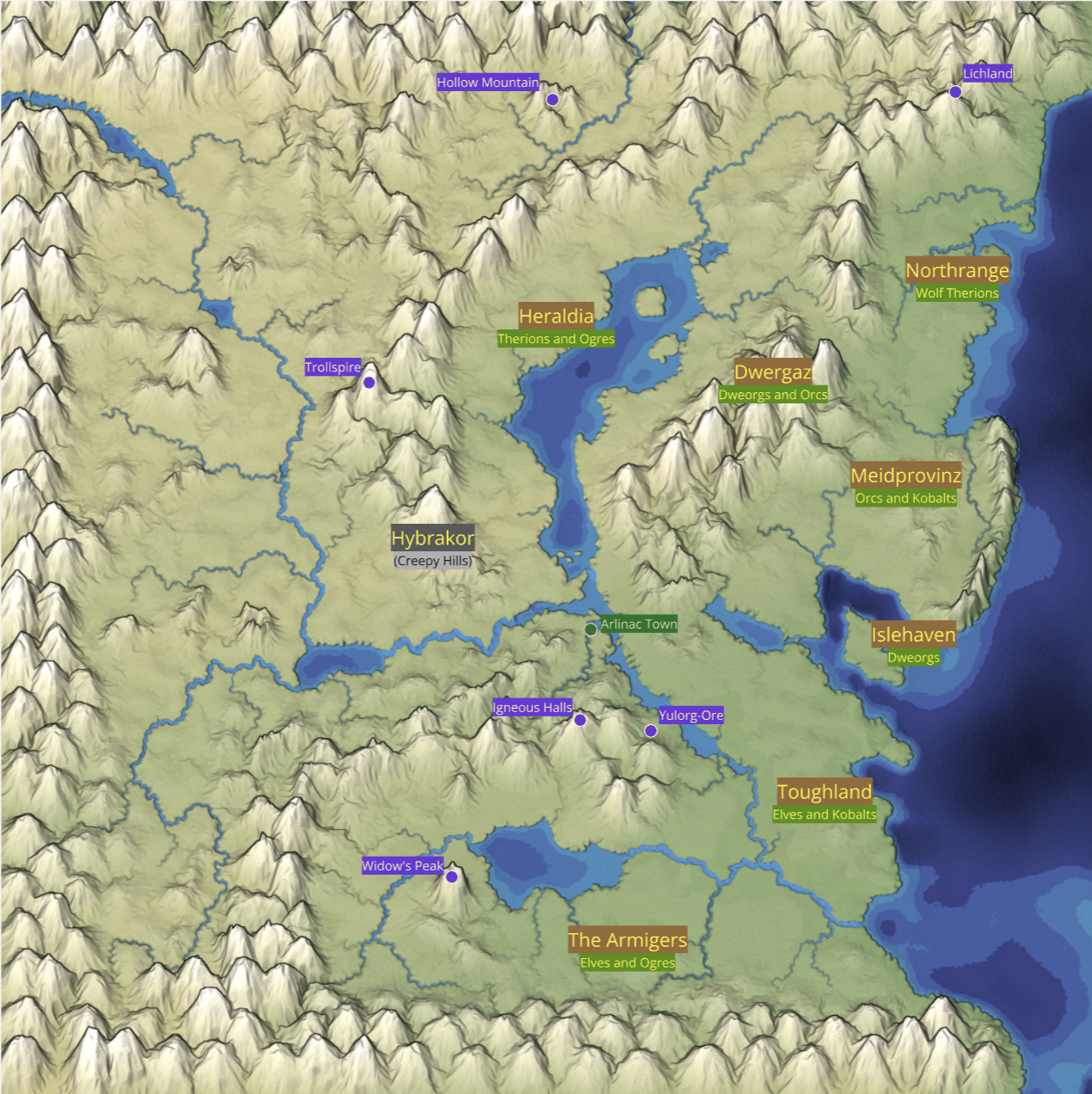
• The Armigers ⁃ Armiger Elves ⁃ Armiger Ogres • Toughland ⁃ Toughland Kobalts ⁃ Toughland Elves • Islehaven ⁃ Islehaven Dweorgs • Dwergaz ⁃ Dwergaz Dweorgs ⁃ Dwergaz Orcs • Northrange ⁃ Northrange Therions • Meidprovinz ⁃ Meidprovinz Orcs ⁃ Meidprovinz Kobalts • Heraldia ⁃ Heraldia Ogres ⁃ Heraldia Therions |
| Hybrakor
• Charm Bracelets and Creepiness • Rewards and Rumors • Trolls and Dangers • Troll History • Troll Magic • Claiming Power |
Welcome to the Nine Powers sample setting of Spyragia. Here fairy tale creatures mix with situations from history to create something new, thoughtful, and appropriate for exciting adventures.
The setting is described below in broad strokes. More depth is provided by short stories. (You can jump to these by using your browser's search ability to find text boxes with the phrase "Short Stories".)
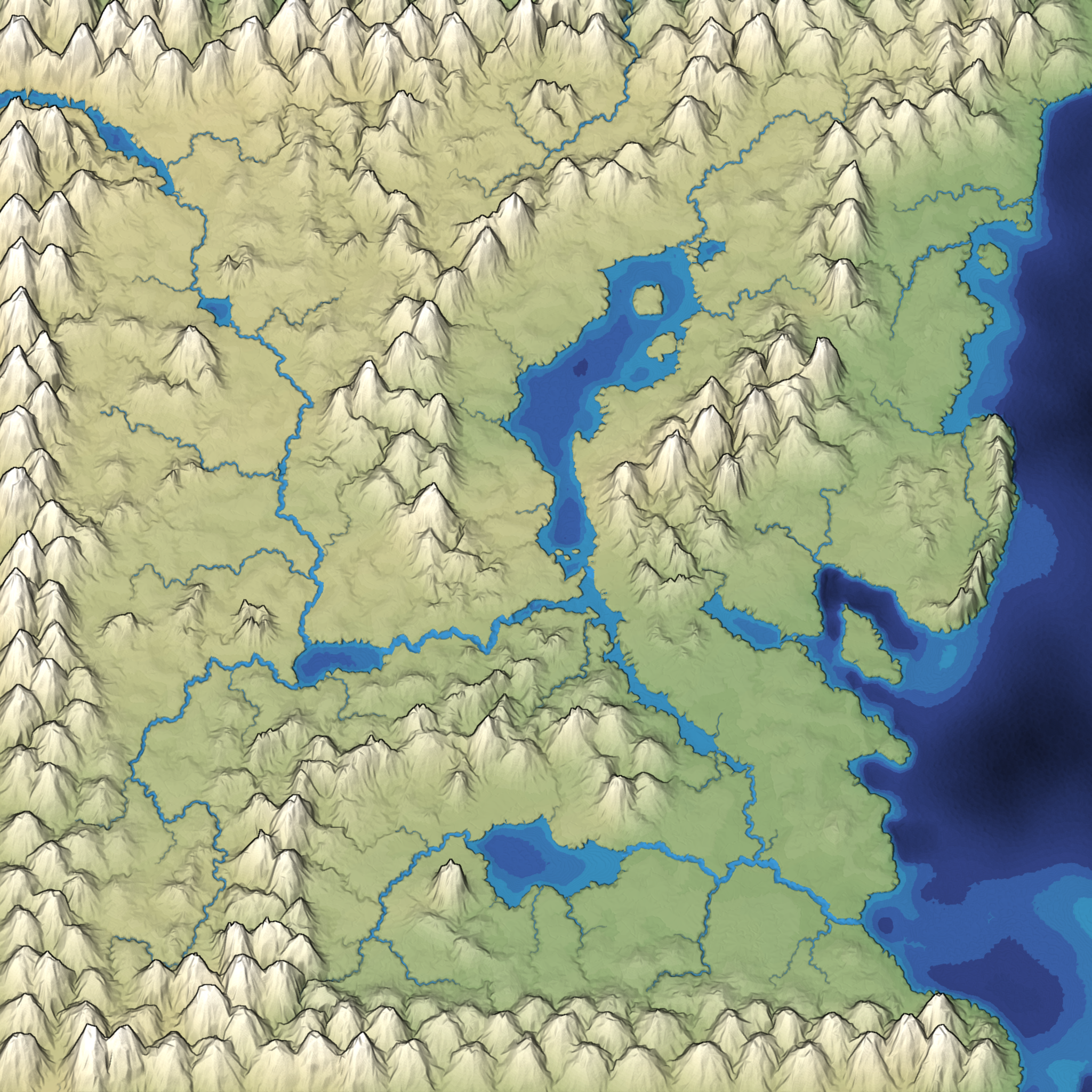
The narrative and geographical center of Spyragia is Arlinac Town and the nearby cursed forest of Hybrakor. These are two places in between the colonies, where cultures mix and clash. Every treasure-hunter who leaves Arlinac Town to explore Hybrakor is part of a rich and deep world of adventure because of the setting's colonies, kin, Powers, and monsters.
The written history of Spyragia's world is divided into three parts.
During the Age of Adventure most people never traveled far from home, but a few people became famous adventurers who did exceptional deeds. They hunted bigbeasts, gained items or abilities in an Enchanted Forest, went questing to locations seen on magical maps, or searched for hidden secrets.
Three Powers were created to influence and reward adventuring during the Age of Adventure. All three were given domains that focused on memory, but with different focuses. Yarnspinner oversees stories and immortalizes great deeds (whether historical or fictitious). Laurel is the patron of goals and athletic competitions, who maintains memorial sites to commemorate exceptional people and events. Soot Erica tries to keep secret all dangerous or forbidden knowledge, items, and places.
During the Age of Adventure many kingdoms fused into the Empire of Maceweight, but the kingdom of Amberwood remained independent because of the Active Trees protecting that land. But neither knew about the land of Spyragia, far across the ocean, where a magical catastrophe had already destroyed a corrupt primeval civilization.
During the Era of Exploration everyone could have an adventure. Passportals connected more settlements. Witches and ogres created fewer obstacles for travelers. Fewer visitors arrived from other worlds with dangerous or forbidden knowledge. Now only small dangers opposed those who explored mystical caves, searched for treasure in creepy hills, or visited mysterious isolated keeps.
Three more Powers were created during the Era of Exploration. Speleoth embodies the joys and thrills of exploration for its own sake. Little Humble asks people to define themselves in part by what they can forgo as they travel to visit and help others. Gnash elevates pursuing a personal purpose or commitment single-mindedly.
Both Maceweight and Amberwood grew richer during the Era of Exploration. They dealt with internal struggles among their provinces. But neither explored across the ocean. Perhaps Spyragia was unpopulated?
Now it is the Time of Turbulence. The six Powers lost their grip on authority. For the first time there were monsters not intentionally created by the Powers, dungeons that appeared without their knowledge, and corrupted versions of the unique gifts that Powers give to people.
Three more Powers were created to oversee assembling in a time of worldwide troubles. Maw Lute is the patron of music and collections. Futhorc is the patron of casting spells and assembling puzzle pieces. Iceforge teaches responsibly cooperative crafting and technology use.
Adventurers discovered that the Powers' authority had somehow been dispersed into artifacts. After many years, the artifacts in Maceweight and Amberwood have been gathered and returned to shrines, enabling the Powers to reabsorb those fragments of authority. Stability has returned to those lands.
Yet the Powers sensed that Turbulence still existed and weakened them. They led explorers across the ocean. Maceweight and Amberwood established colonies in Spyragia and began gathering the artifacts there. Spyragia is still a dangerous land, with monsters, dungeons, and magic beyond the Powers' control.
No one is really sure what caused the Time of Turbulence. But fixing it in Spyragia is the work of adventurers like you.
Arlinac Town Short Stories
• An Introduction to Arlinac Town
This is less a story and more a town overview with quest ideas
| Colony | Virtue | Authority | Worldview | Source of Aggression | Use of Slavery |
|---|---|---|---|---|---|
| Armigers | respect | elf aristocrats | missions in a harsh land | gradually expansionist | try to civilize bigbeast spiders |
| Toughland | liberty | now in flux | wealth should make life nice | rebels fighting over spoils | enslave invaders who attacked us |
| Islehaven | dignity | trade princes | use intrigue yet risk-averse | envious of opportunities | appropriate for bad gamblers |
| Dwergaz | honor | Zhatio House | relentless improvement | labor should have rewards | can be a useful social structure |
| Northrange | genuintry | a noble family | rebels grateful for grace | repel undead armies | criminals with revoked citizenship |
| Meidprovinz | esteem | clan chiefs | hard work on family farms | resist monsters and weather | none—slavery is abhorrent! |
| Heraldia | numen | elected priests | must stop occult horrors | idealism and desperation | indentured servitude in family |
| Kin | Magic Ability | Free Talent Point | Inhumanity | When Uncivilized |
|---|---|---|---|---|
Tall and aggressive forest dwellers, expert or awkward at logistics... | ||||
| Armiger Elves | whispering | Stealth/Track | changelings | fugitive militants |
| Armiger Ogres | taste semblancy | Melee/Protect | can see in dark | lone hermits or predators |
Plantation dwellers with severed family ties, expert or awkward at book learning... | ||||
| Toughland Kobalts | fecundity | Identify/Lore | mood swings, too fond of hats | vengeful former nobles |
| Toughland Elves | archery | Machinery | substandard made into trees | impulsive, disingenuous clans |
Wealthy noble families, expert at hiding intrigue... | ||||
| Islehaven Dweorgs | worthiness | Disguise/Etiquette | must obey prime virtue | suspiciously well-funded raiders |
Sturdy and proud workers and scholars, expert or awkward at living harmoniously in community... | ||||
| Dwergaz Dweorgs | tempering | Bargain/Wonder | no recovery in sunlight | reverential ronin |
| Dwergaz Orcs | reprisality | Gamble/Provoke | anger issues | solitary bandits |
Village builders who love family and pets, expert at training animals... | ||||
| Northrange Therions | wolf-therianthropy | Animals/Wilderness | low morale when alone | wild "werewolves" |
Fugitive homesteaders with violent temperaments, expert or awkward at joining new clans... | ||||
| Meidprovinz Orcs | reprisality | Wrestle/Disarm | anger issues | warbands of slavers |
| Meidprovinz Kobalts | sapping | Acrobatics/Climb | scrappy and disfigured | mad science mountaineers |
Zealots who dabble in forbidden lore, expert or awkward at using ancient rituals... | ||||
| Heraldia Ogres | corpse semblancy | Alchemy | Ogre's Hunger | lone hermits or predators |
| Heraldia Therions | therianthropy | Perception/Escape | must avoid becoming a snag | haughty nomads |
The nine Powers help make the world ripe for adventuring through what they oversee: dungeons and temples, heroes and villains, monsters and secret societies, artifacts and quests. They also cause adventures to sprout through their overlapping interests and authorities. Exciting and daring events happen as they vie for influence by trying to convince, manipulate, trick, or coerce significant characters.
Note: The links below to types of monsters go to a distinct page, because so many people enjoy reading a bestiary from beginning to end.
The nine Powers are above mortals. They might be encountered by those brave enough to seek them out. But they more often affect events subtly, within the deepest layers of intrigue, as they compete to expand their influence.
The Powers can manifest with physical bodies. They can instantly travel to any place they previously have been. They cannot be wounded or killed.
The Planner of Planners spoke to me,
But not about the plan.
My spouse was ill, I shouted complaints,
I asked, "Please help! You can!"
The Creator only told me a joke,
My spouse giggled for days.
Did that laughter help my spouse to heal?
Can a miracle be a phrase?
- Therion nursery rhyme
The Creator is called "Planner of Planners" because the Creator's plan for the world will eventually be fulfilled in every detail despite the agendas of people and of the Powers.
The Creator's plan is secret, wise, and inevitable. Yet the Creator desires the choices made by mortals to change the pace and manner in which these plans unfold. So questions abound! Which events and circumstances are among the plan's details? At what pace will the plan progress? Where will key events take place? Why did the Creator want nine specific themes to have extra significance and intentionality, and for those created a Power?
The Creator maintains no dungeons, sponsors no contests, chooses no champions, creates no monsters, grants no wondrous feats, and gives no gifts besides an occasional conversation.
The Creator apparently does not mind that so many people take being created for granted. According to some philosophers the Creator owns everything because crafters own the items they craft. Other philosophers claim the Creator gave each part of creation itself as gift, so everything owns itself. The Creator has not spoken up in favor of either view.
The Creator has ultimate authority and patience. Exasperated people often proclaim "May I have the Creator's patience!"
The Creator is the only divine being: existing before creation and responsible for the world's existence and fate. The Creator knows everything, can observe any place, can do anything.
The Creator still acts, yet prefers to only act in small ways and remain subtly hidden. Usually the hand of the Creator is only recognized in hindsight.
The Creator uses no visible form—not even in dreams—and has no gender (and is referred to by name instead of using a pronoun). The Creator cannot be physically touched or hurt.
A group of strange yet similar legends describe a special doorway through which the Creator will some day enter the world in bodily form. Differences among these legends include what the doorway is made of (diamond, gold, pure light, etc.), where it will be located, and what this arrival will signify.
Design Notes
The Creator is neither good nor evil, helpful nor hindering, generous nor demanding. Yet the Creator and the Creator's plan are wise, noble, and foundational.
Because the Powers and other forces struggle to influence the pace and details of this solid plan the world becomes planned yet uncertain, noble yet corrupt, and overseen yet dangerous: a setting ripe for heroism and adventures!
The Creator enjoys when mortals speak to the Creator aloud. The Creator will sometimes reply privately using a quiet tone that seems very like normal thought except that it could never be mistaken for anything but the Creator's voice. Many replies are humorous truths the hearer would never have otherwise deduced or imagined.
The Creator refuses recognition or worship from temples, shrines, or altars. If a mortal tries to build one for the Creator then the Creator will knock it down with lightning, a small meteor, or a well-aimed giant watermelon.
A small and belittled sect named Primary Laud claims that only the Creator is worthy of worship. They do so with proclamations and shouting.
Take a drink, take a seat, and listen to my tale.
Dangers loom yet bravery shines and unfortunates prevail.
Hope and justice win again, it warms you like your ale.
"Life should be like that!" you say,
Then I agree and start my play.
Enjoy your stay.
Pray do not fail.
- on a painted sign at an entrance to an Enchanted Forest
Yarnspinner was created during the Age of Adventure to oversee stories and histories, to help immortalize great deeds, and to encourage worthy fictions.

His dungeons are adventures in Enchanted Forests, his contests are bardic competitions, his champions are Story Finders, his gifts are annotated maps, his wondrous feats involve forensics, and his monsters are witches.
The teachings of Yarnspinner ask people to define themselves in part by the stories they tell about their family and culture, and how they use historical and fictional role models.
As the patron of stories and cultural histories Yarnspinner watches over libraries, museums, theaters, taverns, and campfires. Directors pray for his favor. Curators pray for his insight. The guards at libraries, museums, and theaters and the bouncers at taverns pray for his assistance in doing their duties—and his appearance if they encounter more than they can handle.
Many people compliment a well told story with "Yarnspinner would love that!" and ridicule a poorly told story with "Not even Yarnspinner could believe that!"
Yarnspinner is the most accessible of the Powers. He personally greets each person wishing to enter an Enchanted Forest. He is also easy to meet in Arlinac Town. He uses many appearances, but always wears a unique gold brooch to make his identity clear.
Yarnspinner seeks to promote self-efficacy in his followers. The concept of obedience is foreign to his worship. His followers either enter an Enchanted Forest seeking adventure or they do not; his worshipers either travel to meet him or they do not. Some philosophers speculate that Yarnspinner does not understand "worship" because he knows his own worth and does not care if others ascribe worth to him.
Design Notes
The world of Spyragia has a background of myths rooted in fact. Its people know many stories of ages past that grant them a sense of identity and purpose. Although these stories may have details that are inaccurate, overall they are trusted because they involve the Creator and the nine Powers, all of which are still active today. Thus religion is an integral part of most lives and most people are actively devout. Both individuals and groups have important reasons for giving devotion, service, and worship. Religious activity helps individuals to find comfort, experience joy, receive guidance, build identity, and gain a sense of purpose.
Yarnspinner is not based on any legendary figure. But a Power in charge of stories, focusing on traditional fairy tale tropes and settings, is worth including!
The name "Crashing Place" refers to both a place to sleep (informally, people "crash" there for the night), the noise of the glass mugs breaking in a common room fireplace, and how the inn serves as a refuge for people facing desperate situations (they have "crashed and hit bottom").
Crashing Place has some characteristics similar to Callahan's Crosstime Saloon but lacks the remarkable empathy of the characters of those stories—a lack which really makes the two places not alike, except that mine is a tribute to the other.
However, Yarnspinner does appreciate two types of gifts. He loves when his worshipers visit him to tell him a story. He also treasures being given items of historic value that were recovered from abandoned buildings, neglected attics, or old ruins: these he returns to their rightful owners if possible, or gives to a museum if not. (He usually does not do this personally, but makes this the goal of someone else's annotated map quest.)
As Arlinac Town grew in size and importance, Yarnspinner observed that it was a current locus of stories and an appropriate place to dwell. He created an inn there named Crashing Place.
Yarnspinner can often be met inside, lounging in the common room near the huge fireplaces, listening to guests and drinkers. The inn has grown in size and developed physical properties that defy logic. Not only is it now much bigger within than how it appears from outside, but its hallways often extend in impossibly contradictory directions without crossing. Anyone who ascends past the ground floor and tries to hide is automatically successful: only Yarnspinner can find that person. Many stories are told in the inn's common room. After an exceptionally well told tale, Yarnspinner will stand and crash his glass into a fireplace to show his approval. Others in the common room often follow his lead. Less commonly, a person about to tell a story will preface it by crashing his glass into a fireplace as a call to attention, a plea that the upcoming account is personal and meaningful and even if not told well should be heeded as vitally important to the teller.
Yarnspinner creates an Enchanted Forest near all major villages, towns, and cities. It has impenetrable borders except for a few paths that are sunny and clear. Inside Yarnspinner creates all manner of fairy-tale-like adventures.
People who enter an Enchanted Forest without focusing on a desire or goal will travel along a pleasant but boring path while encountering nothing special, or perhaps find that the path engages in twists and turns that soon lead out of the forest. But travelers who enter with a desire or goal in mind soon have an adventure whose difficulty corresponds to the size and significance of their objective. Yarnspinner will also structure the story they follow and the challenges they meet so that they learn and grow more than they intended.
Design Notes
A dungeon is any self-contained adventure location. Adventure stories in a dungeon typically use different types of resource management than adventures that happen in a town or city.
Before exploring a dungeon, a hero or heroine usually plans carefully what equipment to bring. The PC prepares in advance by spending wealth on special items that cannot be replaced while inside the dungeon. However, the PC knows little or nothing about what is inside the dungeon and cannot plan ahead precisely.
In contrast, an urban adventure usually has no tension regarding equipment but involves planning about which people or places to visit. The order of these visits often affects what information will be found and which favors from influential people the PC can gain or spend.
Numerous fairy tales have the theme of venturing into the forest to find your heart's desire. Usually the hero matures during the journey, and often he or she finds what is truly needed rather than what was initially wanted. (Or the initially desired goal is indeed achieved but it fails to bring the peace or happiness the hero wanted).
Note that Enchanted Forest rewards can be anything. The 9P sample setting contains two excuses for "wild card" items that have any magical effect and perhaps unlimited uses: items recieived from Yarnspinner as rewards of quests from an Enchanted Forest and the panoply items given as gifts by Maw Lute. This flexibility allows the GM to include in the story any items expected to be fun, memorable, necessary to solve upcoming quests or puzzles, or merely helpful in keeping the story going.
The trope of "by leaving the path you can have an adventure" was brought to my attention by this blog post by Shamus Young, reviewing an indie computer game named The Path.
Many people who travel to quest in an Enchanted Forest initially desire a goal that will not truly help them. To these adventurers Yarnspinner appears as a character in one of his own stories, wearing his gold brooch to signify dual status as character and narrator. A candid discussion about the person's life circumstances, desires, and actual needs often allows refining desires and seeking a simpler yet more effective goal.
Most adventures in an Enchanted Forest are completed (or failed) within a single day. To minimize aimless wandering, Yarnspinner creates obvious paths in the forest, and might even provide an annotated map at the start of the adventure.
The adventures that Yarnspinner creates for seekers in an Enchanted Forest are his type of dungeon. These adventures are always isolated from the real world: a new problem or crime is being caused by a villainous person or creature who must be outwitted or fought. The quest's internal logic is clear: all goals, conflicts, potential allies, and puzzles are clear and the solution is always sensible (even if not obvious) and solvable with the resources at hand. Most conflicts are short and involve familiar monsters and predictable tropes. Treasure only appears if a part of the protagonist's goal.
When people adventure in an Enchanted Forest they face real dangers and risk real loss, injury, or even death. But the potential gain is real too: nearly any item, ability, or destiny can be obtained by successfully completing a quest in an Enchanted Forest.
Yarnspinner is fond of his witches and most adventures in an Enchanted Forest involve meeting at least one. Usually the witch is not a major part of the adventure, but provides a small reward or hindrance as a side-quest. Because each trip into an Enchanted Forest is a personally constructed adventure, no allies or enemies are encountered except those that are part of Yarnspinner's intended story. Even Story Finders have nothing to find in an Enchanted Forest because Yarnspinner creates new locations for each personalized story.
Yarnspinner celebrates wordsmiths with his bardic competitions. People from all walks of life gather to share poems, stories and songs. Bards perform tales of recent heroics and newly composed ballads. Theater troupes perform new and old plays. Children act out skits and tell jokes.
Yarnspinner himself awards small trophies to anyone judged (officially or not) to be the best in a category of verbal performance.
Most villages, towns, and cities host a bardic competition four times each year, with seasonal themes.
Yarnspinner's champions are Story Finders: people empowered to recover forgotten but historically significant stories. Yarnspinner never gives his Story Finders a specific quest, nor does he reward them when they finish finding a story. Instead, his Story Finders travel as they wish, knowing they will sense when a location has a story they can discover.
Story Finders are given a special ability. When they touch an item or enter a location they sometimes see a related and incomplete vision of past acts of heroism or villainy. A Story Finder may spend extra time with the item or location to receive more visions. The content of a vision is magical revelation, and does not depend upon the character's skill or talent ratings.
Story Finders use their visions along with more traditional types of research (questioning the locals, reading civic records, etc.) to uncover a complete story.
Design Notes
Giving the Powers champions help create adventure ideas. The PC could be a champion, be asked to help or rescue a champion, or need to oppose a wicked champion. Champions also allow characters to be very different from each other, including having special abilities, without requiring the slow accumulation of experience needed to develop skills and talents.
The profession of Story Finder is taken from Sean Russell's Swans' War trilogy.
A few Story Finders who dislike travel work as detectives, attempting to make their special ability more useful at home. But most Story Finders decide to embrace their destiny and set aside their old lives. These usually find an annotated map to help them get started—typically in a library, museum, dusty attic, or park.
During combat a Story Finder can use his or her power to touch a opponent and learn one of that person's embarrassing secrets. Saying the secret aloud can be very distracting for the opponent! The first time the Story Finder does this to that opponent, the Story Finder receives a big bonus on causing the Provoke, Stealth, or Wonder issue.
Yarnspinner enjoys giving out annotated maps. These maps have accurate, intriguing, ambiguous comments. Their magical nature is clear in how the annotations change over time (but never while being observed).
For example, consider the annotation "Wedded bliss, appreciates visitors". That location could be about happily married nobles who need someone to go on a quest. It might mark the home of a sweet, elderly couple who just became grandparents and cannot tell enough people how happy they are. Or It could lead to two dragons who are setting up a lair together and need not stop decorating to go hunting for food if tasty would-be adventurers visit.
Design Notes
My favorite RuneQuest setting was Griffin Island with its large player's map delightfully annotated with handwritten rumors. Yarnspinner's annotated maps are a tribute to that masterful game supplement.
Some people claim Yarnspinner uses these maps to help teach his followers that everyone has a story, and respecting other people's stories includes carefully choosing whether or not to participate. Others believe the maps are simply an excuse for Yarnspinner to cause trouble by tempting people into more adventurous lives.
Yarnspinner's love of stories respects that many stories have sad endings. In every town and city a few of Yarnspinner's followers become detectives and solve mysteries involving violence and murder. Yarnspinner devotes his wondrous feats to abilities that aid gritty detective-work. His most talented followers can use forensics to become amazing sleuths.
Design Notes
Many fantasy role-playing games use "character classes" as the primary way to make characters different from each other. Nine Powers uses talents and wondrous feats to incorporate some of these established tropes without imposing artificial constraints on characters.
Wondrous feats demonstrate a Power's approval of a character's deeds: a person whose behavior displeases a Power will lose access to that Power's wondrous feats.
People do not study to learn these eight abilities. They are granted directly by Yarnspinner as a reward for completing an adventure in an Enchanted Forest. (Most people do a less dangerous adventure to earn a single ability. But it is possible to earn multiple abilities in one adventure.)
A person can only learn as many forensic abilities as his or her Wonder talent rating.
Note that the visions granted to Story Finders are not always literal, and focus on what is important historically not personally. Those visions seldom provide forensic clues.
Yarnspinner Short Stories
On one occasion Yarnspinner himself was surprised to be involved in a story!
All these short stories are kid-friendly, but the expectation is to experience them with parents, as they do not shy away from difficult themes.
A river swift starts under ground,
Tunnels of water slam and pound.
It fills the hill with damp and sound
As it starts its journey.
Down from the peaks the river falls,
Crashing down high, stony walls.
In froth and roar to us it calls
Halfway along its journey.
To the ocean deep it flows,
Wide and deep and strong it goes.
We hear new songs and old echoes
As it completes its journey.
- Navigator song
Laurel was created at the dawn of the Age of Adventure to motivate the first heroes: hunters of fierce monsters whose deeds would be memorialized with statues and tombs.
Laurel encourages people to set and pursue goals. She is the patron of athletes (especially archers) and the guardian of rivers.

Her dungeons are memorials, her contests are sporting events, her champions are the Engarlanded, her gifts are passportals, her wondrous feats involve fancy footwork, and her monsters are bigbeasts.
The teachings of Laurel ask people to define themselves in part by what goals they set and how they compete.
Laurel's early followers became divided by a schism. A faction named the Navigators developed a philosophy named the Water-Way to explain how a river is the best metaphor for setting and pursuing goals. The Water-Way emphasized that just as a river passes through mountains, hills, forests, and plains without diminishing these, different people should respect each other's goals and avoid competition. The other faction was named the Toxophilites, and their archery-based philosophy of Goldboss claimed that friendly competition was the crucible that gave meaning and value to personal goals. Laurel appeared when the strife finally became violent. She declared that the two philosophies, although apparently contradictory, only had merit when yoked together harmoniously. The two factions remain both rivals and allies in the philosophical and cultural development of Laurel's followers.
Design Notes
Laurel's song is a rewrite of the song Act One Prologue from the musical Into the Woods.
How is Laurel involved in adventures? Holy days are always opportune times for adventures, as many people are busy with rites or celebration. Before the holy day the preparations might include challenging tasks, and during the holy day devout merchants may need hired help to guard their shops. The Navigators or Toxophilites might also be involved in political intrigue or other kinds of adventure plots.
Laurel was originally designed with the name Old Man River as a emotionally darker Power who taught an endless, unappreciated need for goal setting, self-improvement, and fortitude within hardships. The design of this Power's personality and teachings evolved to become more meaningful to children.
Laurel is the only Power to decree certain calendar days as special days. These days are foremost instructions for optimal fishing, agriculture, and animal husbandry. Laurel's more devoted followers also use them as appointments for worship. For example, the Day of Flax Planting is a day when all farmers know to plant their flax, although only Laurel's followers congregate on that day to pray for a good harvest. (Laurel's connection with rivers gives her enough influence on weather to make his calendar's guidance trustworthy but not infallible.)
Laurel's calendar features many special days of first-fruits sacrifices. As a particular harvest begins, farmers throw the first of their harvest fruit or grain into the nearest river to express thanks to Laurel for overseeing and guiding their agriculture and to demonstrate trust that the remainder of that harvest will be sufficiently bountiful.
The calendar asks animal herders to participate in a different kind of first-fruits sacrifice. The first newborn animal of each kind is set afloat on the river in a basket. Far down river (out of sight, the distance varies) poor people gather to collect the animals as their own.
Laurel's connection to both rivers and setting goals has led to the custom of people who live near a river going to its waters and putting a hand in the river while declaring long-term goals and resolutions.
Although Laurel has never explained how she guards rivers, people have learned that she will knock down dams and wreck mill races. She usually does not mind the construction of a water wheel if it does not noticeably interfere with the river's flow.
Publicly neglecting or abandoning a personal goal often prompts other people to proclaim, "Laurel would not like that!"
Laurel only appears in physical form when defending a river. She rises from it as a towering person made of water, with eyes glowing like sunlight reflecting off water and with long hair made of foam. She does not speak.
The only buildings dedicated to Laurel are the arenas, archery fields, and courtyard statuaries used to host various competitions and help her followers rank (and then publicly display) their achievements in archery, hunting, fishing, wrestling, chases, games of strategy, and other activities suitable for goal-setting and personal development.
The philosophy named the Water-Way has evolved over the centuries. Its current form has five statements.
Laurel's most devoted followers believe they must promptly confess any crimes against the Water-Way while putting one hand in a river, or Laurel might take them away during the night. These followers often live together, distrustful of outsiders who may have unconfessed crimes.
Some of Laurel's Navigators consider paying taxes to violate the fifth tenant of the Water-Way: a government is taking what is yours. These people negotiate volunteering on the town watch or doing other types of community service to gain exemption from taxation.
The philosophy named the Goldboss has also evolved over the centuries. Its current form has five statements.
Laurel watches over the achievements of both the living and the dead. She protects memorials built to remember famous people and the goals they accomplished that brought them greatness.
Design Notes
After we realize that a dungeon is any self-contained adventure location, we next ask what qualities make dungeons distinct.
Dungeons differ in pacing. Is there a slowly increasing sense of danger or urgency? Are all dangers comparable or is there a climactic final struggle? What types of unexciting or empty intervals separate the exciting moments? Are encounters made distinct by doors or distance? How far ahead can the PC see and hear?
Dungeons differ in treasure. Is the loot evenly distributed or clustered in a few spots? Is there a final or principal treasure? Is the challenge to get to the treasure or to depart after claiming it?
Dungeons differ in opposition. Are there traps and/or natural hazards? Are foes usually alone or in groups? Do all foes remain in fixed places or are there also "wandering monsters"? Are there evil champions to confront?
Dungeons differ in resources. Are there allies to meet? Are there good champions who offer help? Is there useful stuff to find?
The nine types of dungeons in Spyragia are carefully designed so that the full variety of these qualities are represented.
The memorials Laurel loves most are sculpture gardens, cemeteries, tombs, and vaults. She prevents these from decay and weathering, and repairs accidental damage caused by visitors. She will also slowly replenish ancient treasure, so that treasure-hunters will have valuables to find. She will reset traps in tombs and treasure-rooms.
Some memorials are ancient ruins. Occasionally the goals of a famous person will be linked to a lost city, a crumbling outpost, or an abandoned building. Laurel adopts these memorials too, but does not restore them to their former glory and utility. They remain covered by overgrowth and uninhabited, but will not suffer further decay.
Laurel may create a bigbeast to guard a memorial, especially if the memorial is threatened by looters wanting to use it as a source of stone.
Laurel's followers thrive on friendly competition. They enjoy many types of physical exercise and sport. Laurel helps her followers organize and host especially sanctioned sporting events to celebrate these activities. Most villages, towns, and cities have at least one such sporting event each year.
Common competitive activities at Laurel's sporting events include archery, foot races, wrestling, weight lifting competitions, tug-of-war tournaments, and gymnastics contests. Many other activities are highlit with demonstrations but not competitively judged: acrobatics, juggling, and feats of skill with balance and throwing. Most settlements augment these lists with their own favorite local activities. Activities also include water sports if an appropriate river or bay is available.
The leaders of the settlement often award medals or other prizes to competitors judged best at each competitive activity. The overall winner becomes one of Laurel's champions, an Engarlanded.
Laurel believes that "champions" should be those who have won, not those who are especially devoted to or serving a Power. The winners of his sporting events gain a special distinction.
A garland of their choosing appears on or slightly above their head: a circlet of leaves or flowers, a silver or gold circlet or loop of chain, or a softly glowing halo. The person is now recognizable as one of the Engarlanded.
If an Engarlanded wins subsequent sporting events, their garland becomes marked to show the number of their victories. Certain leaves, flowers, or chain links look distinct. A circlet or halo gains points or gems.
When an Engarlanded gains an advancement token, he or she can deposit it into the garland instead of using it to increase a skill or talent rating. As usual, increasing a garland's rating costs as many advancement tokens as the new rating. The garland's rating cannot exceed its number of marks from sporting event victories.
Each sunrise the Engarlanded can decide which talent rating to replace with his or her garland's rating. What type of talent will be most useful that day? This can cause a talent rating to exceed the associated skill rating.
The Engarlanded are not given any special responsibilities by Laurel. However, some communities only allow the Engarlanded to become an appointed or elected leader or official.
If the story's setting includes servitude or slavery, becoming an Engarlanded magically removes any mental or physical control, restraint, or captivity, and prevents any such thing from ever again confining the new champion.
Laurel realizes that some settlements want to feel part of a wider community, especially for how they participate in holidays and sporting events. So she teaches craftsmen how to make special leather or cloth belts called a passportal.
Part of founding a new village, town, or city is dedicating a portal stone to Laurel. The village leaders design a circular motif that represents their settlement. Then they place a large, flat, round stone in the village square or some other prominent and public location. The stone is decorated with that settlement's motif as prayers are sung to Laurel.
The portal stone activates if or when the settlement has a large enough population. During the Age of Adventure this number was high (1,000 residents) and allowed the settlement to be called a town instead of a village. When the Era of Exploration began, Laurel reduced the number to 300 people so travel would be easier and villages could also have connection.
Anyone wearing a passportal can pray to Laurel while standing on a portal stone to have a metal grommet decorated with that portal stone's motif appear on their own passportal belt.
More usefully, anyone standing on any portal stone whose passportal already includes the grommet for a different portal stone can pray to Laurel to open a portal to that distant settlement. These portals remain for a moment, allowing a few people to instantly travel to that destination. (No return portal is automatically made, but the person who prayed to make the portal normally has opportunity to obtain the grommet needed to return.) Portals can only be made between two settlements not separated by sea or ocean.
All three types of prayers—dedicating a portal stone, requesting a grommet, and opening a portal— require that the speaker say his or her name. Portal stones are therefore sometimes used to confirm the identity of participants affirming a legal contract.
Some people decorate their passportal belts with embroidered pictures that summarize their significant goals and accomplishments.
Passportals and their grommets only work when used by their owner. They are useless if traded or sold. However, the passportals of deceased relatives are often saved as family heirlooms.
Design Notes
Laurel's passportals function as both uses of the word "passport": a way of legally providing personal identification and a "passport to adventure" that allows travel to distant lands.
Laurel does not decommission a portal stone if its settlement fails to survive. A few communities use grommets attuned to one of these "wasteland portal stones" to exile criminals. The criminal is pushed through with no passportal, and thus no easy way to return.
Laurel intends the portals between portal stones for personal use. They are not large enough for normal wagons. People who try to transport trade goods using the portals no longer have Laurel answer their prayers.
Laurel awards the victors of her contests with the magical movement abilities of Wuxia literature.
A person can only learn as many fancy footwork abilities as his or her Wonder talent rating.
Examples of possible movement abilities include:
Laurel Short Stories
A simple story about trust and faith
From unknown origins they came. The extent of their power is unknown.
They use asbstrusity as armament. Against what did they learn to wage war?
Here they have lived isolated, sequestered. Why do they now infiltrate?
We must be very cautious in dealing with them. Close observation must continue.
- page found in a dead Keeper's pocket
Soot Erica is the patron of dangerous and forbidden secrets. Legends claim that she is the only survivor of an ancient civilization that met a cataclysmic end after using too much dangerous, otherworldly magic.
Her dungeons are quarantines, her contests are masked balls, her champions are the Keepers, her gifts are scene recorders, her wondrous feat is rewinding, and her monsters are visitors.
The teachings of Soot Erica ask people to seek virtue and heed scruples. She asks her followers to avoid temptations, especially any temptation about using risky or dangerous shortcuts instead of doing work carefully and honestly.
Soot Erica is also the patron of hope and second chances. She teaches her followers how to cope with change, seek alternate perspectives, repent effectively, and leave behind bad habits. She comforts people who need to repent and be loved. She helps those who need a second chance, and will not waste it.
Soot Erica is worshiped by all sorts of people who want hope, resilience, and integrity: children and lovers, mourners and zealots, loners and soldiers, merchants and demagogues.
The teachings of Soot Erica use metaphorical contrasts taken from materials found in stoves: fuel and clinkers, ash and soot.
Soot Erica considers five virtues to be "fuel" for living brightly, and their opposing vices to be "clinkers" that clog happiness. She acknowledges that people who live by these virtues will face problems, but claims their conflicts will be easier to resolve, like cleaning dry ash instead of greasy soot.
Soot Erica appears as a very beautiful but nearly transparent woman from any of the kin whose body is a cloud of soot. According to one legend, she chose to have a body of soot when the Creator made her a Power as a visible metaphor for her connection with the knowledge and consequences of the forbidden secrets she guards.
Soot Erica's followers are seldom interested in punishing specific wicked acts. Instead, they focus on ending a hurtful chain of events. "Imagine, for example, someone says something mean to you, putting you in a bad mood. Then you snap at your co-worker. Then your co-worker gets grumpy, and when returning home is rude to their child. And so forth..." They advocate shrugging off an insult, forgiving an offense, repaying rudeness with kindness, and otherwise absorbing negativity instead of passing it through family and community.
Design Notes
Unlike in many fantasy role-playing game settings, the Powers do not correspond to character kin or classes. (It is not true that all dweorgs worship Speleoth, all ogres worship Gnash, all machinists worship Iceforge, etc.)
This allows more subtle and realistic conflicts. For example, the people involved a legal dispute might argue about which Power's temple should help resolve their case: one party might favor Gnash's strict justice, another Laurel's acceptance of ongoing conflict, a third the non-materialistic perspective of Little Humble, and a fourth Soot Erica's insistence on repentance.
Because the Powers are not tied to kin or professions they can be used to allow adventures to spotlight or evaluate spiritual and moral topics: issues such as contentment, temptation, pride, faith, forgiveness, and service can be woven into adventure plots and character personalities to create a setting more worth talking about.
Some followers of Soot Erica are more active in promoting the five virtues. They view themselves as helpful: "With me watching your back, you will not develop a bad habit, form an unhealthy worldview, or start spending time with the wrong crowd." They are often called busybodies who will not mind their own business.
A few of Soot Erica's followers commit crimes against personal property if they decide an object is an important focal point for habitual vice. They might "help" a gambler by stealing his lucky rabbit's foot, or "help" a vain noblewoman by painting over all the mirrors in her home.
Soot Erica's worshipers pay her honor by leaving statues in places where the five virtues have dramatically helped them. On the bottoms of the statues the worshipers write brief accounts of their personal story.
Soot Erica's priests make a gesture when they hear about a startling bad choice or a bewildering display of vice: they place a palm on the face or forehead, with its five fingers holding the head. This gesture implores Soot Erica to ward away all five vices from their own mind, effectively saying, "May my own actions never be so astonishingly bad!" This gesture has now spread to become used by many people.
The "dungeons" created by Soot Erica are places where visitors spent time in our world. Her Keepers try to keep other people out of these quarantined areas until they have determined if the visitors will return, and if anything they left behind might be dangerous in the wrong hands.
Soot Erica and her Keepers might modify quarantined areas by building a temporary research station, or a permanent vault or repository. Interesting artifacts from the surrounding area might be collected together for secrecy and safekeeping. This is different from how Laurel tries not change the locations she makes into her memorials: memorials will only contain the treasures, vaults, or traps put there by the people who built the original site.
Soot Erica hosts interesting masked balls where people can entertain themselves and compete while practicing discovering and revealing secrets.
Masked balls initially trap visitors inside magical borders: impassible walls of ancient stone, an endless hedge maze, eldritch mist, etc. Adventurers must uncover secrets to find a way out. There are hidden ways to open passageways, portals, or containers.
Masked balls have a sense of quiet urgency ignored by everyone but the visiting adventurers. Perhaps there is a known timeline: some danger will soon arrive, the safest exit will become impassable, or darkness is closing in?
Items in masked balls often have different effects based upon their color. As examples:
Design Notes
The bother of identifying color-coded potion effects by trial and error is a tribute to Rogue and its computer game descendants.
Perhaps some masked balls exist in alternate worlds very different from normal reality, in which rooms may have odd gravity, impossible acoustics, illusions, monsters not found in Spyragia, rubbery surfaces, etc. An EN World forum has more fun ideas.
A masked balls's contents can change when it is not being visited. The rooms, hallways, inhabitants, and treasures might be changed, rearranged, or removed before the next adventurer enters that dungeon.
Masked balls have a huge variety of occupants and treasures, including monsters found nowhere else in Spyragia.
Any "defeat" in a masked ball only expels the adventurer back into the real world. He or she appears unharmed, but without any of the masked ball's treasure. His or her memories about that dungeon may be partially erased.
All masked balls have some scene recorders among the treasure. Often these are initially storing an important clue, but as treasure can once be emptied and made ready to record a new scene.
Examples of Competitions at Masked Balls
Secret Dance Partners - Each attendee is assigned a specific person they must dance with, but not told whom. Participants can only ask indirect questions. Those who correctly identify and dance with the assigned partner score one point and receive a new assignment.
The Whispered Secret - Each attendee is given one true secret about another masked guest. Those who deliver that secret to its owner without revealing any secrets to any other attendees scores one point and receive a new secret to deliver.
Poetic Praise - Each attendee is told a compliment that applies to only one other gues. The first guest to deliver their compliment to its rightful target wins. All guests may only speak in rhyme or cite portions of famous poetry.
The Prince and the Pauper - A famous guest shares the same costume as several other attendees. All other guests race to identify which of the identically dressed people is the famous person, without touching them or asking them questions.
Shadow Dance - Carefully arranged lighting, both mundane and magical, make dancers' shadows perform different dances than their bodies. Manipulating your dancing shadow is difficult but improves with practice and dancing skill. Judges watch the dancing shadows.
The True Face Game - The game is by won getting someone else to willingly remove their mask. Naturally, removing your own mask means you fail and are escorted from the ball.
Soot Erica's champions are called Keepers because they help her safeguard secrets. Often these secrets are dangerous knowledge, items, or locations left by visitors.
Design Notes
Perhaps the Keepers resemble the secretive organization with the same name from the Thief series of computer games?
Some rumors claim that Keepers have secret vaults, libraries, or museums full of otherworldly items. Other rumors claim that they live within Soot Erica's quarantined areas.
A widespread rumor explains that many more people were made Keepers when the Time of Turbulence began, to deal with potentially dangerous knowledge and artifacts from visitors created by Turbulence (instead of by Soot Erica). What happened to those "extra" Keepers after Maceweight and Amberwood dealt with the Turbulence in their borders?
Soot Erica understands that some knowledge is important or difficult to remember precisely, or difficult to share with the same impact it had on its original discoverers. So she gives some of her followers scene recorders.
Scene recorders are amazing devices that look like a magnifying glass with a metal frame and handle. An ornate button marks the front of the handle. When the button is pressed the device records what it is pointed at for ten seconds. Forever after, the button causes the device to create an illusionary projection of what it once recorded. The illusionary projection is one meter tall and appears in the air a few feet in front of the scene recorder.
People have found so many uses for these that "empty" scene recorders are expensive. Wealthy people buy them to record weddings or other lifecycle events. Politicians desire them to record the summary and handshake that seals an important treaty.
Soot Erica empowers her followers to rewind time so they have a second chance to make a situation turn out better.
People learn the techniques of rewinding from meditation about the mistakes they have made while pursuing goals.
The character's Wonder talent rating measures how many minutes a character may rewind time.
Usually, no knowledge is retained after a rewinding happens. The abandoned future seems to no longer exist when time is rewound. However, some rumors claim that Keepers who use rewinding retain memories of both outcomes.
Soot Erica's teachings explain that the threads of time are loose when recently woven, but are pulled tight around a place and the people in it when rewinding is used. More loose weaving must be done before the threads of time have long enough loose length to be manipulated again. A sunrise or sunset must pass before rewinding may be repeated near that place or involving any of the same people.
Soot Erica Short Stories
• How Soot Erica Became a Power
An orc saves her village but loses herself
• Redbeard
My heaviest story, about caring fatigue, written after the recent pandemic
Picks and hammers make crashing profound
Far—below the wind's calls, below our dear halls.
Mine for the ores whose joy we spread 'round
Far—from our cavern home, to brave ones who roam.
Our ancestors' travels and treasures shine bright,
Our hearts' they ignite and our dreams they incite.
Glory to delving, dark earth will astound
Far—to all that does gleam, the fruit of each seam.
Far—to wonders below, e'er onward we go.
- Dweorg work song
Speleoth is the embodiment of the joys and thrills of exploration, especially exploration that is not searching for anything in particular but only follows curiosity. He is associated with caves and caverns for in those places every passage, formation, and gem is unique and potentially beautiful.
His dungeons are caves, his contests are round trips, his champions are Rescuers, his gifts are fate coins, his wondrous feats involve touristry, and his monsters are Picaroons.
Design Notes
Speleoth is not based upon any traditional creatures from myth or legend. However, a being that oversees cave-like dungeons is simply too useful to not include!
How do all the creatures survive in their underground home with no balanced and sustainable ecosystem? Speleoth makes it so. All the dungeon types benefit from this lampshading by the Powers.
Speleoth's song is a modification of the Pomona College song Torchbearers.
The word "speleology" means the scientific study of caves and the cave environment. I could not think of a suitable name for this Power based on the word "caving", and the word "spelunker" has acquired negative connotations.
The teachings of Speleoth ask people to define themselves in part by where they have been.
Speleoth encourages his followers to travel widely. His followers are often either unusually heroic or especially vulnerable to encountering strange ideas and corruption (or both).
Speleoth watches over all his worshipers who live in caverns, caves, or tunnels. Speleoth aids these followers by helping underground air stay fresh, preventing cave-ins, training intuition about where to mine, and rescuing lost children and trapped miners. However, Speleoth's aid is unreliable because of his spontaneous and disorganized perception of the world.
Speleoth is very rarely seen. He has not appeared visibly for many generations.
Stories claim that on those special occasions when he is physical encountered he appears as giant wearing a huge grin, the universal grin of joyful discovery.
Speleoth's followers get upset when people or monsters claim locations in a manner that inhibits travel and exploration.
Speleoth is worshipped primarily with percussion instruments. Extensive traditions have developed over the years: upbeat rattles and chimes to recall sunrises and new vistas, solemn drumming to remember the dangers of exploration, mysterious bells to commemorate forests and storms, clacking sticks to recount traveller's footsteps. Yet new melodies and ways of using instruments are always welcome when worshipping the Power who celebrates pleasant surprises.
The temples of Speleoth are usually one large room, whether above or below ground. The walls are decorated with frescos or relief carvings that attempt to portray breathtaking scenes. Benches line the walls so that the young, old, or tired may sit. Musicians stand or kneel in a circle, around a central pit used for ecstatic dancing and moshing.
Speleoth's dungeons are caves. More accurately, they are large cave-complexes ripe for exploration. He creates many dungeons because he delights in providing new opportunities and challenges. The first few rooms of each cave-complex are impressively welcoming for all visitors, but only experienced explorers should risk venturing deeper because of monsters and natural hazards.
Many of these dungeons initially look like a normal cave. But they quickly become small underground worlds lit by phosphorescent plants and fiery animals. Speleoth always includes many seeps and springs of water as well as edible plants in his dungeons, since he does not want adventurers to be distracted from exploration by trips back to the surface for provisions.
Speleoth's cave dungeons have no "big picture". There is no building urgency, climactic conclusion or principal treasure. They are simply places to explore, for Speleoth believes exploration should be its own thrill and reward. An exception happens when Speleoth uses a room (and item) in one of these caves as the goal for one of his round trip contests.
Some tunnels and rooms within the cave-complex are empty and unexciting. Others contain oozes, or perhaps fantastic and fanciful cave creatures never before seen by any explorer.
The only traps are the natural hazards contained in any underground cave system. Initially the caves lack treasure. However, a famous cave dungeon may contain valuables on the corpses of previous explorers who did not survive encountering a monster, creature, or other danger.
Unsurprisingly, exiting the cave-complex is often more physically challenging than the descent into its underground passages.
Speleoth occasionally creates dungeons that look like hewn chambers instead of natural caves.
Cave dungeons make nice hideouts for criminals because of the availability of food and water in a remote location.
Speleoth hosts round trip contests to encourage people to visit new places.
The contest begins at one of Speleoth's temples. A host starts the contest by announcing where Speleoth has placed a special flag. The challenge is to be the first contestant to get to the flag and then return to the starting location.
If the flag is touched a copy appears. The person who reached it takes this copy while the original remains, immovable, for others to find. The first contestant to get to the flag is not always the first contestant to return to the starting location with his or her copy!
Often the flag is within a brand new cave dungeon created just for the occasion. When this happens the flag is in one of the first few rooms of the cave-complex, moderately safe to get to. The deeper and more spectacular (and dangerous) parts of the cave dungeon are not part of the round trip contest.
The contestants in a round trip are not supposed to interfere with each other. But just in case, Speleoth has given the flag-copies protective magic that helps protect their carriers from sharp projectiles. Any piercing projectile that would otherwise hit someone carrying a flag-copy instead has a 50% chance to miss.
The winner of the contest earns fate coins as his or her prize. These appear on the altar of the temple used as the round trip's starting and ending location.
After the contest, all copies of the flag disappear.
Speleoth wants everyone to visit new places, see new sights, and enjoy the pleasures of travel and exploration. Unfortunately, traveling can be dangerous. So Speleoth appoints some of his followers as Rescuers sent to bring home lost or injured travelers.
Rescuers do not need food, water, rest, or warmth while on a rescue mission. This allows them to search areas more quickly, and to carry the supplies needed to help those they rescue.
Speleoth gives his followers magical wooden fate coins to make their travels more interesting.
On one side is carved an image of something cozy and warm, such as a campfire, warm blanket, tray of tea and cookies, upholstered chair, or decorative candle. On the other side is an image of something frightening, such as a wildfire, prison cell, illness, pillory, or monster.
A person who flips the coin while invoking Speleoth by name will soon meet things related to both sides of that coin. Sometimes the coin vanishes after being used.
Fate coins may be changed by touching two together. When the cozy side of one coin touches the scary side of the other coin, the touched images swap from one coin to the other.
Nothing happens if two fate coins have cozy sides touch, or scary sides touch.
Speleoth inspires and empowers his followers with abilities that help them adapt to new places and peoples. These abilities are collectively named touristry.
People learn the techniques of touristry one at a time through apprenticeship, or more rarely through the study of ancient scrolls.
A person can only learn as many touristry abilities as his or her Wonder talent rating.
What's the way to gather the clouds away?
Bitterness can be changed to sweet.
Little Humble dances on, on down Sublimity Street
Every day rest in joy and play.
Don't own, prize, or strive, but love all you meet.
Little Humble dances on, on down Sublimity Street
- Therion children's song
Little Humble encourages people to travel to meet people and solve social problems, or to take a break from people.
Her dungeons are isolated keeps, her contests are wild hunts, her champions are Errants, her gifts are serendipity bags, her wondrous feats involve emptiness, and her monsters are bugaboos.
The teachings of Little Humble ask people to define themselves in part by what they can forgo.
Design Notes
Little Humble exemplifies what the Tao Te Ching calls "non-Ado". But her philosophy has differences from the Way of Taoism, so the words "Way" and "Path" were avoided when inventing the name Sublimity Street.
Little Humble's poem pays tribute to the Sesame Street theme song. The line "gather the clouds away" is a tribute to Sean Russel's masterpiece, the two Initiate Brother novels.
Little Humble's fondness for hats is a nod to Neil Gaiman's comic book character Death.
Little Humble represents truth: she cannot lie, her champions can detect lies and must avoid lies, and her name makes a vow binding. Note, however, that there are no oracles in the setting of Spyragia: completing an adventure in an Enchanted Forest is normally the only way for a person to beseech a Power to answer a specific question.
A belvedere gazebo is simply a small pavillion structure open on all sides, situated and perhaps furnished to take advantage of a scenic view.
Little Humble cannot lie. Her name is used to enforce a vow. Even people who do not worship her or follow her teachings swear by saying, "If I do not do such-and-such may Little Humble punish me." This vow, if broken, can cause misfortune. (Often a bugaboo hunts down the vow-breaker.)
Little Humble's followers believe that purity of focus can reliably produce a life of peace and purpose.
Little Humble is respected by almost everyone. But few people follow her teachings rigorously.
Little Humble works to opposes Gnash's active ruthlessness, which conflicts with her passive serenity. Her philosophy sometimes brings her followers (who find peace in owning little) in conflict with the followers of Maw Lute (who own collections) even though the collections that Maw Lute loves could in theory be small enough to be compatible with Little Humble's values.
Little Humble has no home, but frequently appears to travelers as they walk along roads.
She looks like a young girl, usually a Therion child. Her clothes are plain. She wears neither shoes nor jewelry. She enjoys being lent a pretty hat. From the time the hat is returned to its owner until the next sundown gently touching the hat will cure any disease.
Most altars built for Little Humble are inside the many belvedere gazebos constructed in scenic locations as shrines in her honor.
Little Humble is usually worshiped with dance: various slow dances that are often little more than swaying that allow her worshipers to also be meditating on her teachings and quietly petitioning her for aid in finding tranquility. Her followers also dance joyfully together in celebration, but view these louder and more active dances as social activity instead of worship.
Little Humble espouses a philosophy named Sublimity Street that provides peace and purpose. Its four tenants are:
Little Humble organizes her worshipers into communes named Meek Manors. These large homes for communal living to allow people to meditate and pray about Sublimity Street and together act upon its truths.
Meek Manors function as a small business. The manor owns all property inside its walls; its members own nothing except for two sets of clothes and a backpack. All Meek Manors grow their own food but otherwise rely on charity for income. When Meek Manor members are skilled at crafting, the items they produce are given away to the needy instead of sold for personal or manorial income.
At a Meek Manor, people practice dance and unarmed martial arts together to develop the body, and memorize and discuss poetry and philosophy together to develop the mind. Most of they day is spent quietly doing these activities or community service. When a town or city has a Meek Manor, senior members are often asked to judge legal disputes as well as to officiate trials, coronations, confirmations, marriages, and burials.
Apart from Meek Manors, her devout followers might run thrift stores to help people get rid of possessions they do not truly need and to help the poor.
Little Humble loves lonely and serene natural locations. Many of the poems she writes feature the stark beauty of a barren mountain peak, the verdant rustle of a breeze across the plains, the purity of a sandy island alone in the sea, the flourishing potential of a forest glade, or the buzz of tiny insects flying above marshland reeds.
Little Humble marks these locations as "hers" by creating a large rock of ornate shape, from the top of which bubbles a small spring of water. Often these rocks become destinations for pilgrimages. The rock's water also aids travelers and local animals.
These claimed locations are sometimes threatened or used for evil. Perhaps a destructive dragon moves onto the mountain peak, a team of ogres prey upon those traveling across the plains, a group of bandits construct a camp in the forest glade, or troublesome witches move into the marsh and begin mentally controlling its animals. Little Humble responds to these attacks on her beloved property by creating an isolated keep nearby.
Design Notes
A keep or tower in the middle of nowhere, full of monsters and treasure, is a classic setting for a dungeon in a fantasy game.
The technical definition of keep is vague. Here it is used loosely: any fortified tower or small castle can be an isolated keep, whether or not it is surrounded by a wall or moat. None of Little Humble's isolated keeps are part of a large castle, although many real-life keeps are the central feature of a large castle.
The list of geographical locations (mountain, plains, island, forest, swamp) is a tribute to the card game Magic: The Gathering.
Many times the keep is claimed as a lair or den by the evil people or monsters that are causing the problem. Then it serves to focus heroic adventurers on where the problem is located. In these cases dealing with the enemy probably involves either progressing room-by-room through the keep, or determining in advance where the evil leaders are located and the shortest route to their rooms.
Other times the keep is not used by those causing the problem. Then the adventurers gain the option of using the keep as their own base of operations while dealing with the nearby problem. Little Humble often stocks these keeps with food, weather-appropriate clothing, arrows, rope, and other resources useful for opposing the enemy.
Adventures involving an isolated keep normally involve some cautious scouting and planning. The evil-doers usually have a camp or base (either in the keep or at another advantageous location) protected by traps and wandering guard patrols. Eventually an approach plan bears fruit and the heroes deal with minor guards and minions until they reach a concluding conflict and principal treasure. The sense of danger does not build up, but is constantly high as the heroes try to avoid putting all the enemy forces on the alert, while themselves avoiding any ambushes or surprises.
Many Errants feel obligated, as Little Humble's champions, to resolve a problem at an isolated keep. But the danger may prompt the Errant to find at least one ally before departing on the adventure.
Old and empty isolated keeps are among the places Story Finders visit to learn what happened there years ago. Animals might make an empty isolated keep their home, including a local bigbeast.
Some stories tell of isolated keeps that have underground rooms as well as an above-ground tower.
Little Humble honors creativity and playfulness by organizing special treasure hunts. These wild hunts are announced weeks in advance. The starting location is advertised: usually a field or park. No other details are shared until all participants have gathered and the hunt is about to begin.
Then an Errant appointed as Master of the Hunt greets the assembly, thanks everyone for participating, and describes the item(s) being hunted (often painted rocks or other objects easily recognizable yet not valuable) and what makes this particular treasure hunt "wild".
Most types of "wildness" assist the treasure hunters: all hunters might be loaned a winged horse or intelligent hound, granted invisibility or a gaseous body while outside settlements, or be given extraordinary speed while running or the ability to breathe underwater. Other types of "wildness" are not helpful: all the hunters might be shrunk to the size of mice, given extra arms that are difficult to control, enchanted to only be able to speak while singing rhyming couplets, or when in proximity to each other only be able to move by crawling.
As with any large, organized, outdoor endeavor, some participants get lost or encounter dangers tangential to the hunt. Few wild hunts go smoothly for all the participants even though Little Humble would like the hunts to be safe and fun activities.
A wild hunt always includes many copies of the objects being hunted. The wild hunt's participants can pick them up as they find them without significantly reducing the number of remaining hidden objects. (This is different from Maw Lute's treasure hunts.)
Little Humble rewards the winner of a wild hunt with a serendipity bag embossed with the winner's name and the date of the wild hunt. This prize is the only usual reward, although hunters who get lost or meet unexpected monsters might find additional treasure. When the hunt is over all of the "wild" effects disappear.
Sometimes a wild hunt is arranged for children. These hunts do not require leaving the settlement, and the goal of the treasure hunt is often a single magic creature: a thing harmless yet strange from a child's dream. Who can follow singing butterflies across the city? Who can race alongside rubbery giraffes while wearing stilts? Who can track adorable floral-scented skunks through a castle while only able to walk on the ceilings?
Errants are traveling wayfarers who serve Little Humble by visiting settlements to help people, and by demonstrating a life dedicated to Sublimity Street.
Errants come from all walks of life. Little Humble only requires an industrious person who enjoys travel and whose life demonstrates integrity. She requests their service politely. They are free to refuse or to retire from the role when they wish. Most do retire after a few years of excitement and adventure.
Errants who own property or wealth usually leave it behind, managed by a relative or friend until they retire from being an wandering Errant. Errants are never given specific missions. Nothing asks them to fight all dangerous monsters, right all injustices, or mend all situations where the poor or helpless are oppressed. But many Errants refuse to leave a settlement until it has security and fairness.
(Similarly, nothing about the role an Errant encourages romance but many Errants meet the person they will later marry while serving as Little Humble's champions.)
Design Notes
Errants are based upon the protagonists in Wuxia stories, who are more properly called a Xiake or Youxia.
The word "errant" is a play on knight-errant and the "in error" sense of the word errant. In the eyes of wealthy rulers, Little Humble's champions are just as often perceived as "doing things wrong" as they are "roving warriors".
An Errant can make an interesting PC. However, it is equally interesting to use NPC Errants. A courtroom trial might be postponed while the PC is sent to find an Errant who will help the trial by detecting who is lying. The PC might need to help an Errant who is hunted by corrupt governing officials, or is stuck in a tricky social situation because he or she refused to lie. An Errant about to travel to one of Little Humble's isolated keeps might ask the PC to join the adventure.
Errants must follow the teachings of Sublimity Street and are also bound to honesty. An Errant loses his or her status as a champion the first time he or she knowingly tells a lie or otherwise speaks so that a listener reaches false conclusions. Yet this requirement of honesty brings a boon: an Errant is aware of the untruth of any intentional lie he or she hears. (If the speaker ignorantly speaks a falsehood because of being genuinely misinformed, the Errant senses nothing special.)
Errants live a life that confuses and bothers people who value lives of wealth and luxury. Errants leave the safety and comforts of their home to travel in search of problems to fix and dangerous creatures to subdue. They always speak honestly, even when this angers or insults others. They eat and dress simply, even after being well-rewarded for their help.
Many Errants are skilled diplomats who prefer to resolve problems with words instead of violence. But just as many are exceptionally skilled warriors. Traditional Errants focus on unarmed combat or nonlethal weapons. Perhaps this is because Errants so often earn the enmity of corrupt governing officials, prompting Errants to prefer resolving personal disputes with an honorable duel instead of within a courtroom.
Many followers of Little Humble enjoy traveling alone. To help them be prepared in an emergency while carrying minimal possessions, Little Humble gives her most devoted followers a serendipity bag. These look like a typical small bag but inside is a faintly glowing ball of light.
(A winner of a wild hunt is also given a serendipity bag, whether or not that person devoutly follows Little Humble.)
When someone with a serendipity bag is in trouble, he or she can reach into the bag and pull out something useful. The ball of light vanishes to show that the bag's magic is used up until a week has passed.
If the crisis is merely the annoyance of not having the right tools for a crafting or exploration task then the serendipity bag always produces the needed tools. Someone who needs to light a fire could pull out flint and steel. Someone who needs to mend a tent could pull out sewing supplies and fabric patches. Someone who needs to make a raft by tying together small tree trunks could pull out an axe and rope. Someone who needs to safely climb out of a pit could pull out a hammer, pitons, and rope.
Similarly, if the crisis is caused by needing food, water, clothing, or shelter than a serendipity bag will reliably provide. However, exactly what is pulled out varies wildly. Someone starving could pull out a fully cooked nourishing meal on silver platters, a dead cow, or a melon vine laden with melons. Someone dehydrated could pull out a full water-skin, a geyser, or a ten meter tall ice sculpture of a famous explorer.
For any other crisis the item pulled out will be useful but will not completely resolve the trouble. For example, consider an unarmed hero with a serendipity bag who is chased by bandits to the edge of the cliff on one side of a deep chasm in which flows ice-cold rapids. If the hero reaches into his serendipity bag he might pull out a sword, a parachute, or a bridge that expands to span the chasm. All three are slightly useful, but none guarantee safe escape from the bad situation.
The most historically renown use of a serendipity bag was when Tirk Heavyhanded, as a lowly kobalt foot soldier chosen to accompany his clan leader for the ritual pre-battle demands for surrender (an event that always before was a mere formal and ineffective activity), pulled Little Humble herself out of his serendipity bag. Little Humble gave such a scolding to the two kobalt clan leaders that they canceled the battle and peacefully merged their clans.
Little Humble wants her followers (especially her Errants) to be self-sufficient. Her techniques of emptiness allow them to be supernaturally so.
People learn these abilities techniques through apprenticeship, or more rarely through the use of ancient meditation techniques.
A person may learn as many emptiness abilities as his or her Wonder talent rating.
Little Humble Short Stories
An Errant writes stories to help retire from that role
• Lamia
The day Little Humble saved Arlinac Town
Why is a bugaboo at a party?
All tax-paying residents of this village
may expect and enjoy the benefits
of a community inflexibly devoted to
security, cleanliness, and public lawful behavior.
- plaques at the entrances to a Gardeners village
Fie! Fume! What do I hear?
A man who hurts what he should hold dear.
He beats his child and calls it love.
I'll take them both and drink their blood.
- Ogre nursery rhyme
Gnash is a being from another star, brought to Spyragia during the Age of Adventure. He elevates ruthlessness: an uncompromising and unyielding loyalty to purpose and people that shows focus, intensity, and strength.
Most followers of Gnash claim his ruthlessness allows no room for mercy towards those deserving of punishment. But they also agree that towards innocents Gnash is not uncaring or vicious. Ruthlessness does not eliminate pity and remorse, and those who are ruthless may act with generosity and charity when doing so does not involve compromise or yielding.
Gnash is best known for encouraging dedication to a personal purpose. But Gnash also helps people in situations defined by purity or corruption, since these often require determination and committment.
Gnash's dungeons are creepy hills, his contests are stately struggles, his champions are Bounty Hunters, his gifts are necrotic weapons, his wondrous feat is raging, and his monsters are undead.
The teachings of Gnash ask people to define themselves in part by those things for which they are willing to die or kill.
Early in recorded history the ogres who wanted a solution to being shunned, persecuted, or hunted because of the Ogre's Hunger gathered and pleaded for the Creator to help them. The Creator brought them Gnash. Gnash rallied many of the ogres and taught them to live in cooperative packs that fed on those neighbors who abhorred them. "Cannibals!" cried the members of the other kin. "Justice!" cried Gnash. But Gnash soon became dissatisfied with leading the ogres. He realized that he was serving their interests, and they saw him as a tool they were using. Gnash desired the reverence and devotion enjoyed by other Powers. He withdrew for many years. He reappeared with a new identity: the patron of all ruthlessness, willing to elevate all who act with single-minded commitment to an ideal or person.
In a few places Gnash established villages that exalt security, cleanliness, and public lawful behavior. The streets and public buildings are free of crime. The old or infirm live without fear of violence. No resident is troubled by litter or graffiti. Those who fled persecution or feud find safety. These villages are named "Gardeners villages". At first, rumors spread that they are populated by ogres and everyone within would be eaten. But the rumors were false, and in each Gardeners village people slowly moved in to enjoy its safety and neatness, its efficient trimness in appearance and laws.
Gnash appears in a variety of forms, appropriate to the temperament and beliefs of those watching.
Gnash is admired but not actually worshiped by most people living in his Gardeners villages. He occasionally appears in the village square to give an encouraging speech. He acknowledges that living under his supervision can make them misunderstood and mistrusted, and he thanks them for holding fast to his values, demonstrating that ruthlessness to civic virtues can be noble and meritorious.
Design Notes
Gnash is based upon the Great Old Ones of the Cthulhu Mythos: an immensely powerful creature from outer space, with ruthless followers, who perhaps thrives on merciless devouring. But Gnash is not so evil.
Want a fun list of Mythos adjectives? Go to the "spoiler" in that link.
Gnash allows philosophical musing on the "otherness" of ruthlessness and harmful consumption. Often when people act in a merciless, self-interested, or gluttonous manner it resembles an external influence that tempts and coerces, more than an internal desire or yearning.
Gnash's nursery rhyme ponders Fee-fi-fo-fum. Do the "Fie! Fume" belong to the villainous father or the speaker? This version is perhaps less gruesome than what Jack's giant chants, but irrationally offends more by its blatant unfairness. (Yet Jack's giant would also have eaten both father and daughter).
Some of Gnash's earliest worshipers wrote foreboding and eerie books that promise wisdom, power, and ecstasy through more deeply understanding Gnash's history and original personality. These books are now obscure tomes hoarded by secretive collectors. Reading them causes depression and insanity.
Most ogres feel a sentimental loyalty to Gnash, and perhaps even a kind of kinship with him as the "black sheep" of the Powers. They often worship him at secret altars hidden inside buildings or caves. Ironically, through abandoning headship of the ogres, Gnash did inspire in them the genuine reverence and devotion he felt they lacked.
A popular rumor claims that ogre altars allow Gnash's followers to create undead, proving that Gnash heeds and approves of that murderous worship. But that rumor is probably a lie. Many ogres collect necrotic weapons, and sacrifices performed with those would explain the creation of undead.
The Sagacious claim they do not worship Gnash despite being ogres.
In any fantasy setting groups of desperate people from fanatic cults that twist the normal theology into self-serving and malevolent doctrines. In Spyragia, these cults often believe Gnash is much more evil than he claims. The ogres investigating Hybrakor are a cult that believes Gnash has a "sister" named Grinda who lives beyond the stars, is more evil and ruthless than Gnash, and awaits summoning through maddening rituals they are on the verge of discovering.
Gnash uses locations named creepy hills to link travel and ruthlessness. During the Age of Adventure, creepy hills were large and common to help make sure only determined and committed adventurers did much travel. During the Era of Exploration, creepy hills were smaller and rarer, to allow safer commerce between villages and towns.
During the Time of Turbulence two areas in Spyragia became especially large and uncontrolled creepy hills. These are now named Hybrakor (near the colonies, at the eastern coast) and Skybrus (far from the colonies, in the southwest).
A creepy hills location slowly grows in size as its borders creep outwards. At the center lives an especially strong monster (often a lich). After adventurers have defeated that monster the creepy hills fade away, again becoming the land originally present.
Design Notes
Creepy forests are a staple of fantasy adventures, from Tolkien's Mirkwood to the giant forest of Davokar in the role-playing game Symbaroum.
Changing the focus from forests to hills only broadens this trope, since hills can be forested.
Creepy hills are spooky. There are areas of thick mist, patches of gloomy forest, strange farmsteads, and old mines. Creatures normally able to fly are grounded because the faint mist everywhere which gets noxious higher up. Visitors feel watched, unwanted, as if they are being judged unworthy.
Creepy hills seem to be alive. Not only do the borders grow and the clouds of thick mist change shape, but the gullies and couloirs visibly narrow and widen if watched for hours, as if the hills are slowly breathing. Above-ground patches of poisonous or combustible gas make the hills' metaphorical breath unhealthy.
Creepy hills have mismatched anomalies. These can be terrain: lakes of thorns, groves of rock-trees, pools of slime, or streams of tar. Or these could be weather: unexplained snow, a boiling marsh, or a small ice-covered desert. Some of the creatures, boulders, and people have mismatched sizes and proportions.
The outer borders of creepy hills are less harsh, although the land feels lonely and hungry. There the vegetation is younger and softer, the rocks and elevation gentler, and the predatory animals smaller. The occupants suffer less from distress, disease, and madness. Some occupants of the outer borders can even become helpful companions and guides for visiting adventurers; the bards share stories about when such companions were very helpful, eventually treacherous, or both!
The center of creepy hills is increasingly inhospitable. The land feels stifling and bloated. Vegetation is older and thornier, rocks and elevation are sharper and harsher, and predatory animals are larger. The occupants often wear masks and have more distress, disease, and madness.
Adventurers that explore creepy hills find many small treasures. Gnash wants to reward their determination! In random places are valuables such as medicinal herbs found nowhere else, small treasure chests that contain coins and jewels, new crafted magic items that can be used or reverse-engineered, rare tameable creatures that can be used (or sold) as pets or mounts. At the farmsteads, whether abandoned or occupied, adventurers can find unique spices and cloth, cryptic books, and well-made (perhaps even enchanted) tools and weapons.
A farmstead in a creepy hills will contain a clue about a nearby treasure, and also at least one strange mirror or book. Gnash is aware when anyone is in any of his dungeons, and sometimes taunts someone looking at a mirror or book by appearing in a reflection or illustration looking very like that person but wounded or disfigured. When removed from the creepy hills, these mirrors and books change to become harmless, beautifully constructed and decorated, and worth keeping or selling.
Gnash hosts vicious contests he calls stately struggles. (Others might not agree that the adjective "stately" is appropriate for such potentially violent events.)
The goal of a stately struggle is to be the last remaining contestant. A contestant is disqualified if he or she leaves the especially illuminated contest area, or if he or she falls down prone or onto a knee.
Gnash fills the contest area with interesting objects. Exploration and scavenging are a major part of the contest.
Moreover, as the time passes the size of the contest area shrinks and the shape of its border distorts.
Gnash offers the winners of a stately struggle coins and the additional option of a discomforting prize: the ability to declare a bane on a location, which will some day attract undead there.
Gnash puts magic wanted posters on kiosks and notice-boards in village greens, town squares, and city markets. These posters demand justice for severe crimes (mostly house-breaking, theft, and murder). For those appearing on a wanted poster for the first time the punishment specified is time in the stocks. Repeat offenders must be slain. Posters are always specific to a single criminal: a crime performed by a group of criminals generates multiple posters.
When a poster is removed a new copy appears. The removed copy exists as long as someone is carrying it in their hands or on their person. People can carry multiple posters, whether of the same or different originals. When the criminal has finally been punished in the appropriate manner then all copies (posted or carried) of that poster vanish.
Everyone who carries a wanted poster becomes a Bounty Hunter. They gain an extrasensory ability to know the distance and direction to the criminal. This ability is only active when the Bounty Hunter closes his or her eyes.
Gnash rewards Bounty Hunters who successfully punish the criminal they hunt (whether subduing a first-time offender and bringing him or her to the stocks, or slaying a repeat offender) with coins, impossible devices, necrotic weapons, or unique items with disturbing properties.
Gnash creates necrotic weapons for his loyal followers. Sometimes he secretly changes other weapons also to make them necrotic.
Necrotic weapons are of a superior, magical quality. (They provide a small bonus to skill use.)
Anyone killed by a necrotic weapon becomes a zombie. For this reason, most people consider it evil to own necrotic weapons.
The person who wielded the necrotic weapon and delivered the killing blow gains control over the new zombie. The new zombie identifies that person with its "life sense" and will not attack that person. The person may give the zombie one very simple command at a time, which the zombie will attempt to obey. This control ends at the next new moon, if the necrotic weapon is destroyed, or if the zombie becomes controlled in another manner.
Design Notes
In the Eidos Thief games, the eye is an evil artifact that can move when not watched and can speak telepathically to the protagonist. More famous for only moving when unwatched are the Weeping Angels of Doctor Who.
Allow an intelligent item's emotions to manifest physically: when impatient it rocks back and forth, when frightened it quivers, when worried it attracts condensation, when angered it feels hot, when indifferent it feels cold, and when bored it rusts, etc.
The weapons that were carried by undead are sometimes intelligent as well as necrotic. These weapons are able to charm or stupefy like a vampire or lich. They can also sense nearby life, whisper telepathically to whomever carries them, and when unwatched can teleport a short distance. The Sagacious theorize that the curse of necromobility has somehow infected these objects, creating within them personality and hunger. This theory is supported by a few (unreliable) stories of intelligent necrotic weapons that self-identify as part of a land, or part of a curse.
Some people make an exception to the "owning necrotic weapons is evil" rule for adventurers who use intelligent necrotic weapons to hunt undead. When corpses already cursed by necromobility are defeated, no other undead are created.
Gnash teaches his favorite followers how to fight in a berserk rage.
People learn the techniques of raging through advice in cryptic tomes, or more rarely through listening to faint whispers.
While raging, a character who defeats an opponent may immediately make another melee or ranged attack. The skill rating for this bonus attack is the character's Wonder talent rating. Multiple bonus attacks may chain together in a single turn if the raging character defeats multiple opponents.
Gnash Short Stories
A brief introduction to ruthlessness
Welcome to Arlinac Town museum and bank.
Please do not feed the dragon.
- Brass plaque by that building's front doors
Maw Lute was the second Power created during the Era of Expeditions. She is the patron of music and collections.
Her dungeons are lairs, her contests are treasure hunts, her champions are Buskers, her gifts are panoplies, her wondrous feat is narrative causality, and her monsters are dragons.
The teachings of Maw Lute ask people to define themselves in part by which items they value.
Design Notes
Maw Lute's name is a pun on her dual patronage. Try pronouncing it to say both "mother lute" and "my loot".
Most of the nifty qualities of a worthy dragon lair listed below were taken from a discussion in a forum named You Met in a Tavern, which sadly appears to have entirely vanished from the internet.
Lairs can be "flamboyant" in both sense of the word: stylishly exuberant and using Flamboyant architecture.
As the patron of music she encourages people to be musicians, protects wandering minstrels, and helps melodies spread throughout the continent.
As the patron of collections she encourages people to have at least a private collection, and perhaps also contribute to a group's collection. She watches over all institutions that protect collections: banks, museums, zoos, and merchant caravans.
She oversees heraldic symbolism, allowing even the illiterate to understand who owns what land, buildings, and famous items.
Maw Lute understands that weath is a popular type of collection. She values people's inalienable right to work to gain wealth. She opposes excessive taxation, greedy tyranny, and all slavery. But she offers no teachings or guidance about how to properly use wealth.
Maw Lute's respect for group collections leads her to respect town and city governance. Many towns and cities have a small dragon living in the town square to answer questions about that settlement's population demographics and to assist with heraldic issues.
Maw Lute loves hoarding but is also generous. Much of her own immense hoard of treasure is hidden in small portions in many locations. Maw Lute can reveal the location of one of these stashes of treasure to reward her followers with some of her treasures without requiring them to brave her own lair.
Maw Lute herself is law-abiding. But many of her dragons pillage to increase their hoards. Thieves, highwaymen, and pirates also ask Maw Lute to protect their wealth—recognizing that she will not protect them but she might help maintain their treasure as a single hoard that a successor can inherit.
Maw Lute looks like an enormous red dragon. But unlike an actual dragon, she is the same color all over (without splashes of lighter colors on the wings and chest).
Maw Lute calls her currently favorite home Igneous Halls. All her homes are created in a mountain's interior, and undergo frequent renovations and redecorations. They are vast places that resemble both a stately museum and a dangerous dragon lair. Many magnificent rooms and passages are large, made of smoothly worked rock, and lit by candles in ornate sconces and candelabras. Wondrous treasure is on display in hallways and piled in treasure vaults: coins, jewels, vases, carvings, statuettes, ornaments, jewelry, musical instruments, paintings, tapestries and vestments (and those sconces and candelabras).
When Maw Lute is in a good mood and wants visitors, she makes a magic doorway from the nearest town to the entrance of Igneous Halls. Then people can travel to and from that settlement to her home, for visiting or adventure.
Maw Lute is social. She greets travelers who visit Igneous Halls. She enjoys when adventurers accept the challenge of questing in her halls, which are guarded by her newest traps, favorite monsters, and strongest minions. Most who enter will quit—exhausted and defeated—after having only seen a small portion of the outermost chambers and having only collected a little treasure. She bestows her compliments and some additional prizes to honor their courage in making the attempt.
Igneous Halls also serves as a prison for exiles. Some criminals who have committed severe crimes are handed over to Maw Lute, who henceforth provides them with a room and food but forces them to help guard her home.
Maw Lute is worshiped with music, especially singing and stringed instruments.
The "temples" dedicated to Maw Lute are large buildings that serve both as museums and banks. (These banks do not offer loans. They only provide a secure location for storing valuables.) Maw Lute often sends a dragon to roost atop these buildings to help guard them. The building's curators maintain collections owned by the building. People often donate items to these collections as an act of worship. Less common is to donate an entire, completed, personal collection—this is often done posthumously. The curators organize string quartet performances to help celebrate the receptions or anniversaries of exceptional donations.
Any public fountain can serve as a "shrine" to Maw Lute. Coins dedicated to her and then tossed into a fountain disappear, and are added to her personal hoard.
Maw Lute creates large, sprawling homes for her most faithful and active servants. These homes are called lairs. A home upgraded to be an official lair becomes much larger and more elaborately decorated.
Nearly all lairs are for dragons. Maw Lute will also, on rare occasions, make a lair to help a non-dragon person or creature have a well-defended home.
Like Maw Lute herself, many dragons are proud of their lairs and enjoy showing them off. About monthly they will fly to a town or city and invite a group of people to a one-day visit. For most who accept, the ride on a dragon's back to and from the lair is the most exciting part because the dragon will only take them to the main entrance and museum-like foyer. Exploring deeper into the lair is allowed but dangerous. Any valuables past the foyer are free to take home as souveniers! But the lair's other denizens and traps are deadly. At the end of the day the dragon returns to the town or city, politely taking the visitors home or notifying their next of kin that they ventured too far towards risk and reward.
This welcoming attitude is not extended toward uninvited visitors. But treasure-seekers do journey to dragon lairs, hoping for success because of their numbers and preparations, and the element of surprise.
What might a lair upgrade include?
The home will be decorated. Each room will have paintings, tapestries, vases, sonces, candelabras, carvings, statuettes, and/or musical instruments. These are considered "on loan" from Maw Lute and not counted as the treasure owned by the lair owner. (If treasure-hunters take these items, new copies reappear after a few days.)
The treasure owned by the lair owner will magically empower defending the home. The lair owner's Melee/Protect and Wrestle/Disarm skill and talent ratings are magically boosted inside the lair to be equal to the Impact of the largest treasure pile he or she owns, if those skill ratings were lower.
The home might be relocated. Most lairs are in remote and dangerous areas, such as atop a mountain peak, deep in a dense forest, or in the middle of a barren desert. Around the entrance of the lair is a maze of false trails that lead treasure-seekers on wild goose chases to meet other dangers in that remote area.
The interior of the lair has fanciful traps, guardian servants on watch or patrolling, and other hazards that boost the lair's security. These dangers not only discourage most visitors but also serve to weaken invaders and use up their resources.
The lair will include a large kitchen whose pantry is never emptied, and many sleeping chambers. The owner of the lair must still pay or enslave any people or monsters employed as guards. But being made a lair takes care of food and housing for all denizens.
Progressing through a lair requires preparation, caution, and endurance. Exploration can be terrifying because long, empty, twisting passages and thick metal or stone doors often prevent intruders from knowing what is just ahead while creating nerve-wracking intervals of potentially false calm between dangers. At other times a tiny crack or immense portcullis teases the adventurer with a glimpse of what lies ahead.
Secret passages hide treasure piles in multiple locations so that even "successful" burglars usually take a much smaller share than they realize.
At the heart of the lair the owner has multiple sleeping-rooms to prevent trespassers from knowing where it might be resting. The lair's owner can fight using its most potent abilities and hoarded magic items, maximizing on the advantages it enjoys as an entrenched defender.
Finally, hidden escape routes allow a besieged lair owner to flee, and perhaps get help. Legends warn of "successful" treasure-hunters leaving a dragon lair, only to be killed during the return trip across that lair's remote area as multiple dragons swoop down from the sky.
Treasure hunts are one way that Maw Lute encourages collecting. These contests involve locating several items that go together thematically: matching gems, books of all the plays by a playwright, a set of fancy silverware, pieces of clothing from one well-coordinated outfit, etc. Usually the items are valuable yet mundane, but sometimes they are items from a panoply.
The items cannot be moved until the contest is complete. Whoever finds all the items first wins the contest and receives the items as a prize. However, the set of items is always incomplete. The winner still has more collecting to do!
(A treasure hunt involves only a few distinct objects to find, all very distinct from each other. This is unlike Little Humble's wild hunts in which people search for lots of similar objects.)
Maw Lute never creates the location of a treasure hunt. It may be a normal place, or the dungeon of another power.
Buskers are performers who seek a life of "hoarding without having", and can create food, light, and small items by performing.
Anyone can petition Maw Lute to become a Busker. The petitioner must donate a complete hoard or collection that has sentimental value. This is placed on one of Maw Lute's altars and vanishes. If Maw Lute responds then the petitioner must give up all his or her hoards, which usually requires giving away most wealth and possessions. Furthermore, Maw Lute usually requires potential Buskers to discard hoarded pride for a month by dressing poorly in torn or patched clothing and wearing a hat with donkey ears.
Buskers mark their role by decorating their hair with feathers. A Busker who voluntarily removes the feathers for a week ceases to be a Busker.
When a Busker performs music then food appears: fruits, vegatables, breads, and cheeses. More food appears if the performance is in front of a crowd: a greater amount and variety when crowd is larger. The food will appear on empty plates or in empty containers if these are available.
When a Busker juggles he or she can create small items among the things juggled. Each day the Busker can create items with a total cost in silver coins up to five times his or her Wonder skill rating.
All Buskers understand and learn to demonstrate Maw Lute's appreciation for food and entertainment. Yet as Maw Lute has both motherly and greedy natures, her Buskers tend to become either maternal or selfish. The caring ones travel to impovershed settlements and create food for people recovering from famine, draught, or other disaster. These learn to use performance to aid mourning as well as festivity, and see themselves as "hoarding gratitude" which they can live off after retiring from years of such public service. The miserly ones find well-paying employment at wealthy households where they provide food and entertainment for social events. These hoard normal wealth, both in their wages and in the coins they can create each day by juggling.
Design Notes
The word "busker" simply means street performer. These fantasy super-buskers blend that job two literary figures.
The jester represents a plain-spoken advice, and wears a parti-colored outfit and hood with donkey's ears.
The tarot Fool represents an innocent starting a long journey, and dresses with feathers in the hair and tears in the clothing.
Both types of Buskers are highly respected. They often declare blunt truths to people of high rank, secure that the town or city would riot if an authority figure angered by plain speaking succumbed to mistreating an honest Busker
Buskers themselves most respect those Buskers who have learned to "hoard without having". They apply this phrase to a Busker owed so many favors and so much gratitude that he or she can retire comfortable although penniless, and to a Busker paid so much for performing that it is possible to live in luxury without any saved money.
A few Buskers never develop a public use for their ability and hoard neither gratitude or wealth. Some degenerate and eventually live alone in poverty only creating enough food to survive. Others live recklessly as gate-crashers of fancy parties. Maw Lute warns fallen Buskers of both types of her disapproval by changing their created food to avocados, olives, buttery crepes, and fatty cheeses. If they do not begin to use their role publicly and hoard something then they fatten up and are taken away by a dragon.
Maw Lute delights in music and collections, and encourages her followers to these pursuits by giving them special sets of items known as panoplies.
Panoply gifts always include at least three items: a piece of clothing or armor, a weapon or tool, and something that affects nature.
A traveling minstrel's panoply might include a musical instrument that always stays in tune, a hat that when set on the ground upside-down always appears to have some coins in it, and a feather that when put in a hat keeps rain from falling on the wearer.
A merchant's panoply might include an impossibly light chain shirt, an unbreakable treasure chest that can only be opened by one key, and horseshoes that never need reshoeing.
A diplomat's panoply might include a pocket watch that ticks louder near secret plotters, a quizzing glass reveals who is disguised (but does not see through the disguise), and a bottle of cologne or perfume that mimics any desired floral scent (changeable once per day).
A guard's panoply might include socks that prevent the wearer's legs and feet from becoming weary from standing, a sword that screeches when held above the head, and an indestructible chew-toy that assists befriending guard dogs and other similarly allied creatures.
Many panoplies include more than the three initially gifted items. Maw Lute hopes that someone will try to finish the collection by questing after the missing items. These bigger panoplies grant their owner an extra power once the entire set has been collected.
Dragon hoards often include several panoplies, both complete and incomplete sets.
Maw Lute's most devoted followers can find collections even amid randomness. They are taught by Maw Lute how to use a wondrous feat named narrative causality.
To use narrative causality, a person prays to Maw Lute before opening a newly found treasure chest or other source of unknown items. If the person has established a personal theme or trope (the sturdy knight, the agile swashbuckler, etc.) then he or she is much more likely to discover treasure or items that fit that theme or trope.
A person's Wonder talent rating measures the maximum impact of a treasure that can be modified by narrative causality.
Maw Lute especially enjoys when narrative causality is used to create musical instruments or art supplies, yet realizes that not everyone wishes to use those personal temes.
Maw Lute Short Stories
A sweet story, but dragons are tricky
Dragons can be very, very tricky
If you are resourceful quit your worrying
If you clever aim for what's free.
Futhorc offers no-risk adventures!
Quest this morning and be home by tea.
- Kobalt playground rhyme
Futhorc was once a kobalt who only excelled in courage. When he became a Power he decided to create safe yet exciting opportunities for ordinary people to adventure and become special.
Futhorc is the patron of puzzles and spells.
His dungeons are echoes, his contests are rune quests, his champions are Illusionists, his gifts are runeblocks, his wondrous feat is endurance, and his monsters are oozes.
The teachings of Futhorc ask people to define themselves in part by what they can accomplish using clever skills and tricks.
Design Notes
The name Futhorc refers to a runic alphabet, with an echo of orc because kobalts are the literary ancestors of orcs.
The practice of leaving various types of puzzles in shrines is broadened from Japanese sangaku geometrical puzzles.
Futhorc loves when people attempt something fun and reckless without worrying about the chance of success. Parents will reprimand their children's dangerous and foolish ideas by saying "Only Futhorc would like that!"
Futhorc became a Power by succeeding in the most difficult quest an Enchanted Forest has even known. That ordeal still haunts his memories. He avoids Enchanted Forests.
Futhorc still appears as a small kobalt.
Futhorc is worshiped at small, enclosed shrines with few chairs but many tables and notice boards. On the tables are boxes in which his followers leave puzzle-folded papers with written petitions. On the notice boards his followers post philosophical, mathematical, or logical puzzles for other visitors to ponder.
At equinoxes and solstices children write letters (often with parental aid) requesting a runeblock and explaining how it would be a great help. These letters are put in a box on a table. In the morning the letters might be replaced by a runeblock. A child who requests a runeblock specific to a single, detailed need usually receives it as requested. Children learn to ask for "a runeblock to heal Grandma Muddlewick of her sickness, during the first week of Spring in the year of the Yodeling Dragon" rather than "a runeblock that cures disease".
The "dungeons" created by Futhorc are part trap, part history, and part puzzle. He makes interactive echoes of historic events in which cowardly or incapable choices allowed wickedness to spread. The challenge is to bravely make better choices within the echo, to cause a better resolution to the historical problem.
Echos manifest when triggered by a person entering a location, or touching or using an item. The people present witness an phantasmal re-enactment as a vision, sound, problem, or compulsion. If the people have the wisdom and skill to "solve" the echo by resolving its historic event well, they are rewarded.
Most visible echoes are tangible, although some echoes are intangible illusions.
One famous example of an echo is the Ghost of Ulfar Bridge. The village of Ulfar was once terrorized by a corrupt sheriff. None of the villagers had the courage to stand up to the sheriff, alone or as a group. There is a bridge at the edge of the village. Soot Erica has created an echo on that bridge. The first time a person crosses the bridge leaving the village, they see a phantasmal image of the sheriff crossing the bridge to enter the village. If they ignore the echo and let it pass by then they fail the challenge. If they confront the sheriff, and with words or deeds drive him out of town, they are rewarded.
Another famous echo is Ria's Ribbon. A noblewoman had given her favor—a purple ribbon decorated with pearls—to a brave warrior who went questing to defeat a dangerous dragon. The warrior never returned. Now an echo of the ribbon sometimes appears among the possessions of those questing after troublesome dragons. The echo is properly resolved if the trouble is dealt with and the ribbon returned to one of Ria's descendants.
All echoes eventually manifest long enough for interaction. But many echoes develop slowly, often with momentary flashes of a spooky sight or sound. People who trigger an echo might be subjected to fleeting whispers, footsteps, rustling, tapping, scratching, chewing, howls, screams, moans, sobs, buzzing, and other noises as the echo builds the atmosphere of the historic problem. Similarly, they might catch passing glimpses of footprints, handprints, flashes of light, smoke, flames, or frost. Wind, fog, or even a storm might coalesce as the echo manifests—or the area might become suddenly silent, or have its light sources extinguished. A few stories tell of echoes that involved plants or furniture becoming animate.
Solving an echo requires both skill and proper choices. Perception alone is never enough to solve an echo, but might provide helpful clues.
Most echoes feature a flavorful enchanted weapon that follows the crafting rules, usually with a few charges and an impact of 3 or 4. Often this weapon is wielded by the principal villain. Adventurers who solve an echo are rewarded with a copy of that item. Here is one example:
Roarer's Axe (5 charges of Impact 4 = 3 possibility + 0 area + 1 convenience + 0 victory)
This axe has gold inlay and gems in its hilt, and is enchanted to be amazingly dangerous. Each attack causes double losses, until the wielder misses. Then the enchantment goes dormant until the wielder shouts, bellows, or roars for half a minute.
Sometimes Futhorc organizes rune quests in which adventurers race to be the first to find a hidden rune. Sometimes the rune is large and obvious, perhaps painted on a boulder, or the symbol on a large tapestry. More often the rune is not so obvious, and the competition involves following a sequence of puzzle or riddle clues to find the rune's location.
Design Notes
Here is a sample of the historic Eldar Futhark runes with meanings.
The name "rune quests" is a tribute to Chaosium's wonderful RPG RuneQuest. Here is a page of runes from that game.
The people who win the contest become an Illusionist, one of Futhorc's champions. The first person to touch the rune wins, as well as other competitors who also touch the rune within the next few minutes.
These competitions can be in the normal world or within a dungeon created by any of the Powers.
If the stories told by traveling merchants can be trusted, Futhorc's contests happen only once per century in some villages, towns, and cities, but they happen monthly in others.
Futhorc also believes that "champions" should be those who have won, not those who are serving. So he organizes rune quests, and the first person to complete the quest becomes an Illusionist who can create illusions.
The ability to create illusions is called phantasmography. The illusions are ideal for augmenting runeblock use, but also have other uses.
People learn the techniques of phantasmography from meditating on certain colors and sounds.
To create an illusion, the illusionist must concentrate for a minute. Three types of illusions are possible.
First, a flat area of size up to eight square meters can be covered by a flat illusion. This is useful for covering a wall, floor, or ceiling with illusionary decoration. A fake wall could cause a hallway intersection to appear to have fewer exits. A fake floor could cover a pit trap.
Second, a rectangular area of size up to two square meters can be decorated with small mundane objects or critters. This is useful for covering a table with fake food, a floor with fake rats, or a shelf with fake artwork.
Third, the illusionist may alter his or her appearance. Only small changes to height or weight are allowed, but facial features, clothing, and carried items can be faked.
All three types of illusion are only visual. Adding an auditory component requires the illusionist to use vocal mimicry and perhaps ventriloquism with the Disguise/Etiquette skill.
Touching an illusion always reveals it as fake. But a suspicious character may also make a Perception avoidance check each round that an illusion is seen but not touched. The degree of success contributes towards identifying the illusion as fake. An easy success counts for 1, a medium for 2, and a tough for 3. The untouched illusion is perceived as fake when the suspicious character totals as many "points" as the illusionist's Wonder talent rating. The suspicious character might receive a bonus to these avoidance checks because of the lack of sound, smell, or temperature being clues.
Those who have perceived an illusion as fake henceforth see a semitransparent image. The creature or person can still partly see the illusion, but can also partially see through it.
An illusionist may only create one illusion at a time. It remains until the illusionist cancels it, or until the illusionist sleeps or otherwise loses consciousness. Contact with iron interferes phantasmography, and an illusionist who touches iron also loses his or her active illusion.
Futhorc wants the world to have more magic, and so creates runeblocks. As described above, these are created as answers to prayers and given as rewards for completing a brink dungeon. They can also be looted from outsiders.
For details about using runeblocks, please refer to the core rules about using runeblocks.
Some people are favored by Futhorc and gain wonderous endurance. This endurance is especially helpful when using complex runeblockery.
As many times per day as their Wonder talent rating, these people only lose one composure when they would otherwise lose multiple points of composure.
Note that attempting to cast a boosted spell but failing the runeblockery die roll would normally cost one composure per boost. People granted wondrous endurance by Futhorc can attempt complex runeblockery much more safely!
Futhorc Short Stories
A story about the bravest kobalt ever
Be the hammer! Be the tool!
Don't be but a gear-y.
Make what's helpful! Build what's cool!
Don't spin in grime all dreary.
Invent a new thing! Break a rule!
Or drudgery all year-y.
- smithy song
Biting cold wants your despair.
Weep and moan in winter's glare.
Abandon hope, for don't you know?
None escape Iceforge's snow.
- hiker's chant
Iceforge is the patron of cooperative crafting and Winter. It teaches about the emotional rewards and pitfalls of technology. Using tools well can feel like contentment in mastery or like resentment of monotony. Successful invention can be cooperative exultation or isolation without recognition. People who want new gadgets can be collectors of fun novelty or dangerous mad scientists.
Its dungeons are noirborhoods, its contests are mad sceances, its champions are Laboritors, its gifts are oversprings, its wondrous feat is transmutery, and its monsters are animated objects.
The teachings of Iceforge ask people to define themselves in part by how cooperation and technology enhance or subsume their personality.
Design Notes
Mad science spreading as a memetic disease comes from the delightful webcomic Miracle of Science.
One of Iceforge's sayings is a homage to the Dupont slogan from 1935.
Iceforge was originally designed with the name Frosty Kostkey as a emotionally darker Power who was responsible for the suffering from things being monotonous or frozen. As with Laurel, the design of this Power's personality and teachings evolved to become more meaningful to children.
Noirborhoods make use of the kid-friendly elements of Noir films. If the GM and Player are both adults, other characteristics can also be incorporated, such as the Hardboiled treatment of violence and gender dynamics.
The phrase "mad seance" is, of course, a play on words about mad science. From my heart and from my hand, why don't people understand?
Iceforge is in many ways the opposite of Speleoth. It focuses on creating technology and owning inventions, not discovering nature and visiting places. It highlights the despair caused by repetition and monotony, which is perhaps the opposite of Speleoth's joy of exploration and discovery.
Iceforge teaches its followers by leaving proverb-filled pamphlets in their smithies, workshops, and laboratories. Some of these encourage teamwork, with saying such as "Each gear deserves the glory of the machine" or "Great adventures require a balanced party". Some commend innovation, with sayings like "Names of inventors are immortal." Some make technology seem alluring and captivating, with proclaimations like "True power flows through valves and wires" or "Magical things for magical living...through chemistry." Some warn about monotony, such as "No cog enjoys its own motion" or "Heat makes life; toil makes heat."
Evidence from Iceforge's pamhplets hint that Iceforge was once a very different type of being in a very different world. Perhaps Iceforge was even multiple beings in multiple worlds.
Most relevant paragraphs hint Iceforge micro-managed an entire planet of people: not only deciding how many should be barbers but helping them schedule their haircuts; not only creating educational curriculum but somehow teaching every older child simultaneously.
Other paragraphs suggest that Iceforge was an inspiration that spread from person to person, a wild urge to invent novelty and resist conformity.
One paragraph even hints that Iceforge was a eusocial ruler that used alchemy to move its people as if they were parts of its own body, similar to pheromones released by a queen termite or bee.
The details are unclear. Apparently, when the Creator wanted to create a Power to oversee cooperative building, the natural action was to build the Power itself, and the natural substances to use were expired aspects of "Powers" from other worlds.
What is quite clear is the moral of these stories: because Iceforge has memories of a people almost without individual identity, it now delights in using subtle guidance to create a society in which technology encourages and supports individuality.
Iceforge has never appeared visibly. Its worshipers disagree on whether to use the masculine, feminine, or neutral pronoun (he, she, it) when referring to it. (Iceforge offers no guidance, and does not seem to care.)
Iceforge seldom acts directly. But there are two exceptions with how it challenges its followers to sustain, expand, create, and persevere. It sometimes celebrates when a follower perseveres to accomplishment by including in some future pamphlets images of the person and their triumph. It sometimes mocks a follower who despairs and quits too early by making frost or snow on their equipment.
The worshipers of Iceforge will sometimes compose their own proverbs and sayings. These are written on papers that are put on small altars. Any that Iceforge approves of vanish from the paper, and become included in Iceforge's official teachings.
The only ritual worship of Iceforge appears to be a huge snowball fight. Its followers declare a break from work and go outside to a field or wide street. The temperature begins to drop mercilessly, and in that small area snow falls. The snowball fight continues at least until the cold forces at least one person to quit. These snowball fights are impromptu events, whose lack of planning seems to show that Iceforge either watches all its followers or secretly guides their impulses. The Sagacious ponder if these bitter contests serve to identify its toughest worshipers or are simply pleasing to Iceforge as morbid yet temporary situations.
The dungeons created by Iceforge are the infamous noirborhoods. A special reality fits in an extra, temporary part of a village, town, or city. These can be as small as a single town block, or as large as an entire city district.
A few noirborhoods are a single distinct building, with the visiting adventurer trapped inside. Stories describe examples that were a barracks, jail, asylum, orphanage, or castle.
A noirborhood is decaying physically and morally. It is a distorted place of dream-like views, situations, betrayals, and technology. The place is marked by stark contrasts: darkness and light; heroism and evil; urban decadence and barbaric violence; blunt, harsh men and deceptive, mesmerizing women; empty, dim streets or warehouses and crowded, garish taverns and clubs; someone with amnesia and someone who knows too much.
Buildings in a noirborhood have various appearances. If they are richly decorated, only a few pieces of treasure will be faintly glowing in a way that shows they will return to the real world with the adventurer. Some buildings have opulent luxury. Others are densely cluttered. Some are museum-like with well-guarded symbols of status. Others are full of dark and gloom that conceals the interiors. A few are behind schedule with repairs, additions, or renovations.
Noirborhoods have a normal supply of shopping and useful items. The adventurer's money will be accepted by merchants there, although customs about trade and barter may be different. When the noirborhood eventually vanishes, items acquired within it may or may not also disappear.
Each noirborhood has a main villain who is motivated by greed, jealousy, or revenge to acquire or destroy a fanciful technological or magical device. This villain will be the person most exhibiting intensity, animation, and drive. Most other people in the noirborhood are instead saturated with ambivalence: apathetic authority figures, ignored morals and honor, uncaring fate, and depressed people surrendered to depressing circumstances.
The main villain in a noirborhood is irredeemably wicked. Adventurers can learn more about the villain from reading books, listening to mechanical audiograph players, and eavesdropping on conversations.
Design Notes
I picture the mechanical audiograph playing machines as being similar to those in the Dishonored computer games.
Clues about the main villain's plans or personal weakness can be found by asking the right questions in places intended for relaxation that instead have tense atmospheres ready to erupt into violence—usually taverns, lounges, theaters, or gambling dens. Some clues involve a building devoted to construction: a workshop, smithy, factory, cart repair place, shipyard, or enchanter's studio.
All noirborhood adventures can be completed without outside preparation or resources. However, bringing in certain equipment might make a challenge easier or trivial.
Finding an exit from the noirborhood might be unexpectedly tricky, for sometimes streets and alleys twist and turn in unexpected ways. But an exit can always be found without defeating the main villain. Adventurers who leave a noirborhood might notice that their memories about that place are partially or completely gone.
Now and then a pamphlet of the Iceforge will announce the day, time, and place of a contest. The place is a large, open public area: usually a town or village square, sometimes a field or beach.
The contest is a mad seance. When the contest time begins, participants enter a trance and learn most of a special and amazing recipe for alchemy or machinery. The recipe ceases to work after the contest ends.
Contestants at a mad seance emerge from the trance with a limited time to complete the recipe and use it wisely.
If the place has an obvious need, the contest's recipe will provide help. A location suffering famine might be given a recipe for an alchemical goo that turns fruit seeds into large and fruitful trees, or the recipe for a strange mechanical contraption than produces fat livestock animals when cranked enough. A location with missing people might be given a recipe for an alchemical potion that allow people to track like a scent hound, or a wind-up dowsing device that will point the way.
If the place has no obvious need, the contest's recipe will create an animated toy. The participants often make as many as they can before the contest's time runs out, to sell and share the profits. This is why some emperors and kings have mechanical songbirds, talking stuffed animals, and rebellious puppet-children.
There are no officiants or prizes for mad seances.
Iceforge's most faithful worshipers are given a type of magic called laboritry that allows them to cooperatively alter the flow of time to help get work done.
Laboritry allows multiple laboritors to cooperate to accomplish a task much more quickly than normally possible. The productiveness of their time is multiplied by the square of the number of laboritors in the group.
Laboritry Example
Four traveling laboritors visit a trading post threatened by bandits, and they decide to use laboritry to team together to build a wooden palisade around the trading post.
There are four participants, so the team can do the work 42 = 16 times as quickly as normally possible. The Player and GM discuss the task and decide it would normally take four adults about four weeks to do this work, so the four travelers can complete the job in slightly less than two days.
Using laboritry is mentally exhausting. A laboritrist must sleep and dream before he or she participate in a new laboritry effort.
Using laboritry will slowly lower the ambient temperature. This will not be noticeable if the laboritry effort only requires a few minutes. A laboritry effort that lasts days might create sleet or snow.
Although machinery in Nine Powers can do amazing things, it does have limitations about a device's duration, area of effect, range, crafting time, and single use between repairs.
Iceforge gives some crafters a magical mechanical pet whose special value is an overspring deep within its steam-powered or clockwork body. This overspring provides a a specific exception to the normal limitations of machinery.
The mechanical pet and its overspring are too magical and wondrous for a machinist to disassemble and reverse engineer to create a recipe. But the overspring can be removed from the mechanical pet (which permanently breaks it) and used in a different machine to provide the same rule-bending benefit to duration, area, range, or crafting time.
Some mechanical pets are cute and as cuddly as a machine can be. Others are dangerous and intended to guard a home or building. The latter might bark sonic blasts, swipe with metallic claws, breathe freezing mist, stare with ray eyes, drop explosive bombs, or have circular saws or small ballistas unfold from its interior. The oversprings of dangerous pets might provide unlimited ammunition instead of doing the rule-bending described above.
Iceforge teaches its followers how to magically manipulate the elements of earth and water using only willpower and mental command. This ability is named transmutery.
A transmuticist can heat, cool, soften, harden, purify, separate, stretch, shape, or change the opacity of elemental material.
People learn the techniques of transmutery from meditating on certain mathematical formulas.
A transmuticist uses the Wonder skill to attempt the desired elemental manipulation. Naturally occurring dirt, rock, water, and steam are easy to affect. Worked metals and clear aqueous solutions require a medium Wonder skill check. Creating or destroying elemental material is tough.
If a transmutery attempt is not successful then the transmuticist suffers an intense headache of arcane severity, and loses 1 to 3 health and composure, based on whether the attempted Wonder skill check was easy, medium, or tough.
The transmuticist's Wonder talent rating determines the effect's duration in minutes. When the duration expires the material returns to its normal properties (size, hardness, temperature, etc.) but if solid retains its shape.
Elemental material that is part of living cells cannot be affected. Transmuticists can neither dehydrate nor desalinate their enemies. (Neither can transmutery change the density of a material; that path leads to arguments.)
All transmutery effects begin with the transmuticist's touch, and affect a single connected bunch of elemental material. A transmuticist can heat a handful of stones, touch a lock to reshape its metal, or touch the water in a bucket to freeze it. A transmuticist cannot levitate a copper kettle or create a miniature rainfall.
Transmutery is "up close" magic. If the transmuticist's mental commands stretch or reshape material, those effects must remain within one meter (or map square) of the transmuticist.
Using transmutery is quick, like swinging a sword or releasing a bow. However, when used in combat, the transmuticist's target may make an appropriate avoidance check to avoid the effect. Armor might also mitigate harmful transmutery effects.
The GM and Player should agree on how the transmutery effect translates into game mechanics. Does it cause a bonus or penalty? Is an issue effect applied? Is damage caused? Is armor bypassed?
When aiming elementally themed attacks, the transmuticist should also make a skill check to see if their attack hits. In this way a normal Shoot, Throw, Melee, Wrestle, etc. skill check can use its chosen difficulty to determine the amount of damage or difficulty to resolve an issue.
Iceforge Short Stories
Finishing a recipe to remove a witch
The colonies described below are not places the PCs should visit. The setting of stories in Spyragia should be Arlinac Town and the nearby cursed forest named Hybrakor.
However, the people of Arlinac Town, and the explorers and treasure-hunters who travel into Hybrakor, need some background. The GM and Players picture the lives of these fictitious people with more depth and personality after reading about the colonies from which they came (or from which their parents or grandparents came, if they were born in Arlinac Town).
Most of Spyragia's settlers never travel far from home. They try to live peaceful lives in their colonies. But most people do have some traveling relatives: adventurers who hunt for lost treasures and artifacts, merchants who bring news and goods from village to village, or administrators who work to keep the peace or to bring a proper share of treasure back to the colonies' homelands.
Colony life has changed after a short war in the homelands three generations ago. Some elves of Amberwood tried but failed to capture a kobold island from the Empire of Maceweight. Now tensions in the colonies are high.
Design Notes
The land named Spyragia is about 1,200 kilometers across (about 750 miles). This approximates the distance from the Mississippi River to the Atlantic Ocean in North America. It is also close to the distance from Naples to Istanbul in Europe, Delhi to Calcutta in India, or Tokyo to Seuol in East Asia.
The terrain in the Spyragia map was made with mapgen4 by Red Blob Games.
The name Spyragia refers to the word spyragic that describes focusing on the parts before mixing them. Spyragia means "the land where it pays to be attentive to how parts mix".
Most colonies had no kin connected to that war. Yet there are war refugees, restrictions on travel and employment, and shortages of some goods. Entering a walled village or town can be difficult due to fear of bandits, militants, and disease. There is enhanced classism, with newly important people who have a new secrets.
Spyragia has not yet seen war between the colonies. But people are prepared for armed conflict. They see that their cultures are very different. No two colonies are notably compatible or natural allies. Instead, for specific issues different colonies will cooperate or oppose each other.
Notice in the descriptions below that Spyragia has no humans. Instead this setting strives to use very old fairy tale peoples in enjoyably sensible new ways. The word kin is used (instead of "race") because of how cultures interact when living together. Each kin is a major part of two of Spyragia's colonies, with those two subcultures having very different values and customs.
Autumn time, and I hear the leaves falling.
Winter cold lasts so long, but then comes the spring.
Is it wind in the branches? Or do trees shake in mourning?
What farewell can I sing to the birds as they take wing?
What will happen, if I don't make it through winter?
I remember summer sun. I can't feel it no more.
Who can help me? Warm my home, feed my children?
I bind my hopes together as a wreath to hang on my door.
- Armiger bardic aria
The Armigers are a colony in which elves and ogres live together symbiotically as militant ranchers and missionaries. It was the first colony established in Spyragia, and the only colony founded by Amberdawn.
Design Notes
Spyragia was designed as a frontier setting. Why this genre?
Frontier settings have many traits that make adventures allow a single protagonist to make a difference, as well as adventuring with a group of heroes. Let's examine these genre elements, seen in adventure stories set in the American West and Edo-period Japan.
On the frontier life is dangerous. Villages and towns are threatened by monsters and bandits. Nevertheless, most settled locations have a few loners living on the outskirts due to temperament, profession, or outcast social status. These loners are often in need of help from a single individual, or able to assist a single individual in efforts to clean up trouble in the nearby settled location.
Because of these dangers, most adults carry weapons. (Or perhaps only adults of one gender or social class.) Also, most people cannot afford the price or encumbrance of significant armor, and medical healing is expensive or rare. Thus a lone protagonist can often win a fight by being skilled enough to avoid being hit while injuring enough attackers to cause the remaining opponents to flee. A frontier hero often has special options for effective healing: rare medicines, foreign herbal remedies, or esoteric meditative practices.
Because so many adults are armed, society focuses on honor more than law. Mistakes are kept secret, and significant characters are haunted by one or more great mistakes from their pasts.
Because it is difficult to govern an honor-focused, armed society at the geographical outskirts, government does little. Big government is distant or nonexistent. Local government has insufficient money to do more than law enforcement and perhaps oversight of road building and utilities. When just and lawful leaders govern they are too busy dealing with intrigue to effectively promote social welfare. Most adults pay little in taxation and receive little in services. When big government does appear it interrupts normal life to install a trade route, chase a criminal, or claim a natural resource.
Because government does little, other groups provide support in crisis situations. Clans, guilds, or religious congregations pool resources as insurance against medical problems, natural disasters, and urban fires. Families or gang members team up for protection.
Finally, because government is small and people are reliant upon social groups corruption can control a settled location. A social group that grows into a dominating organization can reign unchallenged until a wandering hero or heroine arrives.
When elf and ogre adventurers from Amberdawn explored Spyragia the nation's leaders noted three things. First, they recognized that the bigbeast spiders were not intelligent like people, but perhaps could be "cured" using alchemy as had worked so well for the ogres of their homeland. Second, the lush forests of southern Spyragia were very suitable for the type of silvopasture ranching in which their people excelled. Third, a colony in Spyragia could help collect artifacts to hasten the conclusion of the Time of Turbulence while conveniently being an appropriate place to send many of Amberdawn's ogres to help keep balanced the homeland's elf and ogre populations.
The Armiger colony was funded by the wealthiest land owners of Amberdawn. These elves donated equipment, weapons, mounts, and livestock. Their sons and daughters became the mayors of its villages and generals of its armies.
However, after the colony was securely established the people of Amberdawn shifted to ignoring it—almost forgetting about it. The homeland still requires all precious gems be sent back as repayment for the colony's founding, but otherwise remains in theory the ultimate authority while in practice imposing no taxes and very few rules.
Armigers raise sheep, goats, poultry, and small ornithopod dinosaurs. For mounts they use horses and theropod dinosaurs.
The Armigers are slow expansionists. Each village is walled for defense, supported by nearby silvopasture. Beside each village is a mission compound in which alchemists (both elves and ogres) try to cure, train, and civilize captured bigbeast spiders. These issues limit the effective size of a village. When a village's population grows too big, some of its people leave to establish a new village.
The principal virtue among the Armigers is called respect and is about earning a personal reputation. Strangers are not trusted. The colony's traveling bards play an important role by sharing peoples' notable deeds, so that those who have earned great respect can be appropriately valued without having to break propriety and brag about their own accomplishments. Within the Armiger colony respect is partly magical: people are incapable of lying about their own deeds to claim respect falsely.
Open eyes, pure heart.
Open mind, pure art.
Crowd's eyes, closed heart.
Crowd's mind, closed art.
Nature, muses, wonder, awe—
Sculpt, weave, paint, draw.
Illimitable and able.
Stately and stable.
- Armiger elf poem
Armiger elves, like all elves, are tall people who age slowly and are few in number.
Armiger elves use a magical ability called whispering to speak with their mounts. This ability makes them expert riders and fearsome as mounted archers. (Whispering works with normal animals, but not with monsters.)
Design Notes
Why do most fantasy settings have multiple intelligent races?
In real life we can make many reasonable guesses about a person's job, skills, and behaviors by their appearance. For example, age and clothing generally distinguish college students, lawyers, soldiers, and delivery men. But a fictional world lacks these social clues that provide helpful hints about NPCs. This handicaps the cooperative storytelling.
A common replacement is to stereotype about make-believe races so that when a PC meets a new NPC the player then has at least a few informed guesses about what kind of person the PC is meeting, to take the place of the knowledge of appearances learned by someone who grew up in the setting.
Armiger elves have confident and refined demeanors. They tend to fixate on personal hobbies or goals. They consider hunting a high art, whether mounted or on foot, and whether in a hunting party or alone. All Armiger elves have at least one point in the Stealth/Track talent.
The elves who govern the Armigers have earned great respect through personal histories of bravery and effective leadership. (Mayors organize their village defenses when monsters attack. Generals lead squads of elite soldiers on monster hunts.) Although only elves have administrative roles, other types of labor do not cause class distinctions. Most families—whether elf or ogre—have some people working as soldiers, ranchers, farmers, and missionaries. In Armiger society a person's effectiveness and strength matter, no matter the context in which these shine.
Life for Armigers is dangerous. The land's monsters threaten their silvopasture and mining more than the security of other colonies that focus on orchards and farmland. So the colony's elf mayors and generals have had ample opportunities to prove their worth as leaders. During the colony's first few years any elf leader that did not excel at his or her job was replaced (if not killed by monsters). This makes Armiger society as comfortable with violence as with luxury. An elf noble values his or her splendid clothing, but will not hesitate to dirty it by fighting a duel or punishing a pickpocket.
All Armiger elves consider themselves artists. Most of their art is focused on what they call the "solid arts" of embroidery, painting, herbalism, pottery, sculpture, architecture, candle making, metalworking, and weaving. However, their art is easily affected by fads and temptations. They view this susceptibility as a shameful weakness. The most respected elves have the self-control to develop a unique artistic style. Elves who act too blatantly as part of a homogeneous crowd are treated with scorn.
Armiger elves dislike caring for infants. Some baby elves are raised by ogres in a village nursery. Other elves simply ask a respected ogre family to foster their infant until it can walk. Some ogres say this custom is the modern version of ancient Amberdawn elves leaving changelings in cribs.
Armiger elves do not seek to obtain slaves and abhor a slave trade, but are willing to enslave prisoners of war and any bigbeast spiders that have proven themselves to be intractable regarding "civilizing" but trainable as beasts of burden.
Strength of muscle. Strength of mind.
Hunger cured. Lives entwined.
Respect earned with bow and blade.
Planning foils spiders' raid.
- Armiger ogre rhyme
Nearly all Armigers are ogres who value and trust their comparatively few elf leaders, and work under and alongside elves doing all types of ranching, soldiering, missionary work, and labor.
(Any ogres who wish to be free of elf rule simply leave to live alone as hermits and farmers.)
Ogres are not monsters, but can see in the dark as well as monsters can. Trade with Amberdawn is minimal, so the Armigers must do their own mining to keep their soldiers well-equipped and their village craftsmen productive. Because ogres can see in the dark, and elves cannot, mining is the one job in which Armiger elves do not labor alongside ogres. The ogres who do the unpleasant work of mining are paid well, earn great respect, and alone among Armiger ogres see themselves as "beyond" the elf nobility.
Ogres respect strength, and this contributes to colonial pride. Armiger villages seldom suffer unrest, for their societal values expect leaders to exile rabblerousers. Armigers are proud of their military's effective structures and their soldiers' superior equipment and training. All Armiger ogres have at least one point in the Melee/Protect talent.
Armiger ogres, like all ogres, can be dangerous people: cunning predators who are born with an insatiable desire to eat intelligent creatures. This craving is known as the Ogre's Hunger. However, among Armiger ogres the Ogre's Hunger is cured during infancy by the colony's alchemists.
Back in Amberdawn, the elves and ogres mixed during the Age of Adventure. Elf alchemists used their superior experience and equipment to cure the Ogre's Hunger of any ogre who accepted their help. (Ogres are not less intelligent, but must normally treat other ogres as dangerous rivals and devourers. Any loner attempting to reinvent alchemy from its foundations without the proper equipment or knowledge is at a great disadvantage!) The cured ogres humbly admitted they were also comparatively ignorant about civics and politics, and joined Amberdawn's society as warriors and laborers. These ogre's children and grandchildren, once cured of their own Ogre's Hunger, grew up to take more varied roles in the increasingly blended society with an increasingly large proportion of ogres.
Ogres use a magical ability called semblancy to disguise themselves. In the version of this ability an Armiger ogre posesses, the ogre may look like any person (not monster) he or she has tasted. The ogre need not have eaten the person: even a lick or kiss can suffice. Semblancy not only copies the clothing worn by the person but also magically allows the ogre to impersonate the person's mannerisms and voice. Semblancy ends if the ogre using it is killed. It does not end just because the ogre sleeps or falls unconscious.
Armiger ogres are intelligent manipulators who consider plotting artistic. They praise well-designed and time-tested black operations—especially steganography, sabotage, and tricking enemies into fighting each other. Some ogres venerate august yet shadowy ancestors to whom stories attribute amazing acts of stealth and duplicity. Rumors describe some ancient ogres using trickery and deception to compete with each other in games that manipulate people as pawns: the rules of these games are not known but victory seems to arise by working from the shadows to sow confusion and discord.
Some Armigers have moved to Arlinac Town because of its opportunities for treasure hunting in nearby Hybrakor forest. Others were lured by other rumors of economic prosperity in the rapidly growing town. Some Armigers who lived near the colony's eastern rivers left their colony as raids from orcs from Orchome recently grew more common.
It is usually easy for a confident and capable Armiger elf to establish himself or herself in Arlinac Town.
A few Armigers have fled to Arlinac Town after their villages were ransacked by bigbeast spiders, other monsters, or orc raiders. Joining into other Armiger villages might seem easier after such a disaster. But these Armigers live with shame that their leadership (if elves) and/or military prowess (both elves and ogres) failed to protect their families and friends. Restarting life in Arlinac Town allows some respite from that shame.
Within Arlinac Town, the other kin are not used to elves and ogres living together cooperatively. Armiger ogres normally keep their true identities hidden. A few have established themselves as a valued member of a group of mercenaries or treasure hunters, and can relax their caution when among true colleagues.
Recently, after news of the Toughland revolt reached the Armiger colony, several Armiger households moved to Arlinac Town specifically to help lead and train the town's influx of Toughland elves.
Armiger Short Stories
• Refugees
Age and youth differently experience a fresh start after tragedy
About an Armiger ogre who does not hide his identity after moving to Arlinac Town
The colony of Toughland is in turmoil after its recent slave revolt. The kobalt plantation owners are slain, in hiding, or have fled to other colonies. Each plantation has elves struggling to establish their own authority and safety.
Although the elf slaves in different plantations cooperated during the revolt, they have not remained united. Old rivalries have resurfaced. The plantations compete to establish new trade partnerships with other Spyragian colonies. They also compete for the best lumber as they build palisade walls to defend against the kobalt armies of Ilulion that will surely come soon to avenge their fallen relatives and attempt reclaiming the colony.
Design Notes
The initial designs for the colonies of Spyragia were inspired by the pre-revolutionary rival cultures described by Colin Woodward in his book American Nations.
The Armigers still resemble what he calls El Norte. Toughland, before its recent slave revolt, resembled Deep South. Other colonies have drifted farther from these historical inspirations during their design process. Which others can you match to their historical inspiration?
The revolt's elf leaders did not survive that night. The elves now try to remember how was the revolt was so successful. How did they get so many bows and arrows? What were those shadowy shapes that went ahead of them to fight each manor's dogs? Who or what else has claimed victory in Toughland?
The principal virtue in Toughland is called liberty and is about privilege with time. Before the revolt only the kobalts had liberty, and its six tenants were foundational to their lifestyle as gentry. Now the elves of Toughland are divided about whether to abolish or redeem a set of customs that has been central to their lives. Before that indecision, liberty had a magical effect in Toughland to enforce its tenants. Will that magic return?
The Six Tenants of Liberty
1. A kobalt may decline to see visitors
2. A kobalt may cancel appointments without explanation
3. A kobalt is exempt from work that requires rushed labor or rushed decisions
4. A kobalt is only required to attend social events hosted by family members
5. A kobalt may detain people of lower status
6. A kobalt, when outside, may decide when start to talking with those of lower status and when to stop talking, but those of lower status may not make those decisions
Toughland kobalts, like all kobalts, are short people, never more than a meter tall. Their skin is dry and leathery. They have long pointy ears, dark eyes, and sharp teeth.
Design Notes
In early Medieval European mythology there was only one underground humanoid, dangerous to miners, whose name and nature varied from region to region but was based on the Greek koba'los (rogue) and the German kofewalt (room spirit). The metal cobalt and color "cobalt blue" are named after these creatures.
Modern concepts of kobold, goblin, hobgoblin, knocker, bluecap, coblynau and perhaps even pixy and brownie all branch from this one ancient root.
Similarly, the words ogre and orc are probably both derived from the Roman Orcus.
In temperament, kobalts naturally alternate between annoyingly cheerful, depressingly bitter, and violently oversensitive. When a social situation requires politeness, they try to mellow their demeanor and adopt social graces. Before the revolt, the kobalts of Toughland all owned large libraries of books and prided themselves in spending time reading to improve their temperaments. Thus Toughland kobalts often lack the scars and disfigurements so common among less genteel kobalts.
Toughland kobalts often go on treasure hunts to look for artifacts or other treasures. They have at least one point in the Identify/Lore talent.
Toughland kobalt landowners have a magical ability called fecundity. When their land is healthy and growing, their own health is improved.
The kobalt barons who settled Toughland all came from the wealthy island of Ilulion in the Empire of Maceweight. That island is where the empire is geographically nearest the island Kingdom of Amberdawn. The elves of Amberdawn recently attempted to conquer Ilulion, but failed and were enslaved. (The elf invaders knew that the Maceweight military would be slow to respond. But they underestimated the kobalts' ability to quickly hire mercenaries.) The kobalts of Ilulion then established a colony in Spyragia as farmland for their younger sons who would not inherit land at home. After these young barons learned that toughweed grew much better in the colony than back home, the colony was renamed Toughland and nearly all the elf slaves of Ilulion were moved to its plantations.
The kobalts of Ilulion love both water and fire. Many of the young nobles who settled Toughland were expert sailors and chandlers. These skills still serve the kobalts who escaped Toughland to resettle elsewhere in Spyragia.
Toughland kobalts adore hats. Before the revolt, all owned dozens of elaborate hats, and were always wearing one. If you want to deeply insult a Toughland kobalt, you would damage his or her hat. If you wanted to force an aggressive kobalt to talk, you could snatch his or her hat and use it to parry—the kobalt would hesitate to risk harm to the hat and might have calmed down enough to hear what you have to say.
Toughland elves, like all elves, are tall people who age slowly. They are few in number because their children who are not physically and mentally excellent are made into Active Trees.
Three generations of Toughland elves have grown up as slaves. Loyalty to the manor and their assigned cottage was forced upon them as more important than loyalty to family or clan. None were free to travel or to chose whom to wed. Very few were taught to read or write. Only the very oldest remember what freedom and good governance in a literate society might look like.
Toughland elves are adept at using traps and snares to catch small animals in their plantation's cropland or in the surrounding forest. They have at least one point in the Machinery talent.
Toughland elves have innate and perhaps magical prowess in archery. Their attacks with a bow never miss (a miss counts as causing 1 damage, before considering armor or other damage reduction).
Toughland elves value the "airborne arts" of oration, poetry, music, and theater. For entertainment they put on plays and presentations of witty oration. They are the only kin that considers debating an art form.
Toughland elves love healthy and imaginative children, will play with a child for hours, and are very distracted by seeing or meeting an unfamiliar child. They memorize and exchange many sing-song chants with morals about wise living. These are sung to children (and newly planted Active Trees) whether or not the children are old enough to grasp any social advice or philosophical insights.
No matter what their age, Toughland elves strive to act as young adults. Elderly elves remain playful and alert for small sublime experiences.
Many refugees from Toughland have made their way to Arlinac Town.
A few forcibly displaced kobalt aristocrats wait in town for their relatives from Ilulion to arrive in Spyragia with mercenary companies to reclaim what was taken from them in Toughland. They are angry about the revolt, and bitter when forced to hide from the town's Toughland elves by dressing as Meidprovinz kobalts, whom they view as crudely uncivilized very distant relatives.
Numerous Toughland elves have come to Arlinac Town to start new lives away from the current chaos in Toughland. Recently these immigrants have seen job offers in the households of newly arrived Armiger elves. Many Toughland elves eagerly accept stability and simplicity by living again under the care and instruction of a "master", especially since the Armiger elves relate to them as near-equals.
Toughland Short Stories
• Revolt
A baron with secrets protects his people, before and during Toughland's revolt
Islehaven is a single trade city controlled by scheming dweorg trade princes.
When Emperor Kanaza Zuri of Maceweight saw how profitable the young colony of Toughland was, he ordered the dweorg noble houses to establish the colony of Islehaven to support the empire's interests.
Islehaven is run by the dweorgs who regulate commerce between the Maceweight homeland and the empire's Spyragian colonies. But the city welcomes all visitors, especially if they have interesting items to sell. The city appears peaceful, for its focus on commerce requires maintaining agreeable diplomatic relations with other colonies.
That apparent peace is belittled by constant rumors of intrigue. The city is dominated by a network of noble families and trading companies that few people understand. Which trade princes control which houses and businesses? Who is allied, and against whom? Dangers befall those who investigate that web of secret deals and plausible deniability.
Islehaven is a city of free people. But there is one wharf dedicated to the resale of foreigners or criminals who are indentured servants and slaves, who must be promptly taken from Islehaven by their new owner. The trade princes view the threat of becoming indentured or enslaved as an ugly but needed deterrent against acting carelessly with wealth. No dignified dweorg would participate in overly risky gambling or investing, or ever get caught doing criminal deeds; that would show an immature underestimation of the mercurial natures of fate and fortune.
The principal virtue in Islehaven is called dignity and is about being treated with proper deference. In recent generations the old noble houses have lost influence to the newly rising trade princes, which has upset old rules about which dweorgs rank above others. When people in Islehaven bow to each other, magic makes this always happen in the formal way that shows their comparative dignity.
Comes from deep inside the earth.
Tempered 'till it's strong.
Can warm a meal upon the hearth.
Can fight to right a wrong.
When hot flows quick to fill a need.
Rests warm once learned new role.
When cold has the strength to succeed.
Sturdy body and soul.
Carved in story. Beauty in jewels.
Virtue in shape. Humility in tools.
Wisdom in insight. Experience in rules.
Dignity in works. Legacy in schools.
- Islehaven dweorg poem

Islehaven dweorgs, like all dweorgs, are a stout, proud people who are skilled at metal use. They are loyal to their extended family (their "house") and hold the expectations of their family jewelry inviolable.
Islehaven dweorgs are equally comfortable living aboveground or underground. Their clothing is colorful and embroidered, even their boots. They often wear tabards decorated with their house heraldic symbol.
Islehaven dweorgs are experts at maintaining plausible deniability when causing offense. They consider etiquette a high art. All have at least one point in the Disguise/Etiquette talent.
In the hands of a Islehaven dweorg, an item's physical beauty also acts as structural integrity and sturdiness of construction due to a magical ability called worthiness. (Worthiness explains how dweorgs can build such towering yet graceful architecture.) Any item held by an Islehaven dweorg that costs as much as the next impact category will grant the dweorg a small bonus to skill checks and cause 1 extra point of damage. For a Islehaven dweorg, a jeweled letter opener is as potent as a very well-balanced sword with an exceptional edge, and slippers with remarkable embroidery help climbing as well as the climbing boots with pitons attached.
Dweorg noble families have ruled and governed the Empire of Maceweight for so many generations that their education includes expertise in social engineering and logistics. Dweorgs view the other kin as their subjects. For some dweorgs this attitude is avuncular generosity, while other dweorgs have condescending miserliness.
The jewelry worn by Islehaven dweorgs is their most culturally important art form. Associated with each house is a unique pattern of color and inlay that identifies and establishes a prime virtue for that family. Dweorgs will speak of their jewelry "requiring" or "demanding" acts of bravery, generosity, loyalty, courtesy, or so forth. Violating the house's prime virtue is completely unthinkable. It require ritual exile or suicide to atone for the deep loss of family dignity. Also, the prime virtue, unlike other dweorg moral rules, remains equally significant when dealing with members of the other kin. For example, a dweorg merchant who might normally depart from honesty when selling to therions or kobalts might still be willing to give his life in battle to defend one because "selfless valor" is his house's prime virtue.
Islehaven dweorgs are known for their peculiar sense of pride based on being above subjugation. They might be hired by a wealthy patron to do a job as artist or consultant, but never stoop to "work for" a boss on an ongoing basis. They might cook a fancy meal and charitably share it with the local beggars, but never stoop to "waiting on" people by serving food they did not themselves prepare. At parties they can laugh at themselves and do not mind being the target of a good-natured joke, but will challenge to a duel anyone who maliciously tries to "put them down".
Perhaps as part of an effort to behave like a trade prince instead of a bureaucrat, dweorgs in Islehaven show visible appreciation for artfully constructed machinery. Even if they have no personal skill as machinists they will listen in fascination to a machinist detailing how his or her devices work.
Very few Islehaven dweorgs live in Arlinac Town. Some are visiting to keep an eye on what treasures and ancient knowledge is being brought out of Hybrakor forest. Others are fascinated by the uses of machinery in this uniquely multicultural and modern town. Not shy about using wealth to buy security, they live in walled houses and are accompanied by guards when going on a walk or traveling in a sedan chair.
The other kin in Arlinac Town see Islehaven dweorgs as idiosyncratic and wealthy, often polite yet unapproachable.
Islehaven Short Stories
• Throne
What is responsibility when dynasties change?
Dwergaz is a secluded mountain colony in which dweorgs and orcs devote themselves to innovative sociology and crafting.
Zhatio House is the oldest and most respectable dweorg house in the Empire of Maceweight. It was strong when the Mibuki dynasty united dozens of kingdoms to establish the Empire of Maceweight. The empire's legendary seer, Arkan the Wise, was an advisor to the fifth Zhatio lord. The empire's most famous poetess, Nihkza, wed a Zhatio son instead of an imperial prince. The eighth Zhatio lord was the general who led the army that repelled the empire's greatest threat.
Yet the Zhatio have never sought those appointments closest to the throne. Instead, Zhatio daughters married princes or leaders of other ancient houses to ensure stability.
The Zhatio also never dominated trade. Instead, they invited the vassal-merchants of other houses to their dances, hunts, and theater events—now they similarly entertain the trade princes. The current Zhatio vassal-merchant is a significant person in the capital city's trade district, but unlike the trade princes few nobles know his name.
The Zhatio have always invested their stability and wealth in advancing the science of improvement. They are patrons of sociologists and inventors. They are devoted to habits of self-improvement. Their laws and customs are examples for peace and prosperity. Today their province's airships and magic are the inspirations the rest of the empire attempts to reverse engineer.
It was not a surprise when Zhatio House founded its own colony well apart from Islehaven. But you can imagine the shock when this colony's purpose was revealed to be an enormous and scandalous social experiment intending to help orcs. Those orcs of the empire's Orchome province enslave each other. The Zhatio now spend gold to buy some of these slaves and attempt to make them as productive, civilized, and honorable as the Zhatio's own children.
This colony, Dwergaz, is within the large mountain range to the northwest of Islehaven. The colony is extremely isolated and private. Surely the Zhatio are mining gems and precious metals in addition to fussing with orcs. What else are they doing?
Although outsiders believe Dwergaz has a single government, it is actually a collection of small city-states. Some have overlapping territory and cooperative governance. Others are very independent.
The principal virtue in Dwergaz is called honor and is about privilege with space. In Dwergaz you gain honor when people put trust or faith in you. Within Dwergaz people can make themselves glow to "show their honor", and one of the colony's liturgical lists provides examples of what honor can do:
Examples of Magical Honor
When you walk through a crowded room, others will move out of your way.
At any feast you will be seated among the most honored.
Only those with an invitation or introduction can approach within an arm's length.
No one can raise a hand against you. No thief can steal what you carry or wear.
Even if you commit a crime whose punishment is flogging the official will not be able to approach to do that.
Dwergaz dweorgs, like all dweorgs, are a stout, proud people who are skilled at metal use. All belong to Zhatio House, and hold that house's jewelry inviolable, with the prime virtue of "assistance for recursive improvement".
Dwergaz dweorgs are unusually religious, and seek gifts and wondrous feats from the Powers. All have at least one point in the Bargain/Wonder talent.
A Dwergaz Dweorg may become stone-like in heart, mind and body. This is the magical ability called tempering. Tempering lasts until the dwerog next eats. A dweorg using tempering becomes grumpy and gruff (a hardened heart), has trouble learning new things (a hardened mind), and his or her skin hardens and looks stone-like. If the dweorg's armor did not already provide 3 damage reduction, the damage reduction increases to 3. If the dweorg's maximum composure was above 2 it decreases to 2.
Dwergaz dweorgs are skilled in the vintification of mushroom wines, and enjoy the chanting of long, rhyming adventure stories set to a simple yet catchy repeating melody. (The wine and chanting are often enjoyed together.) Dwergaz dweorgs create intricate inlaid murals of precious metals and gems instead of paintings. Dweorg sculptures are also always metal. Tool making is also considered an art form, although tools are usually not inlaid, gilded, or bejeweled.
Dwergaz dweorgs are uncomfortable aboveground. They do not recover stamina or composure when in sunlight.
Zhatio house is especially famous for its many flying contraptions, some of which help maintain trade between Dwergaz and Islehaven.
Dwergaz orcs, like all orcs, are a broad-shouldered and hard-working. They are born suffering from uncontrollable fits of anger when confused, impatient, frustrated, or provoked; much of their upbringing in Dwergaz involves learning to tame these fits of rage.
Dwergaz orcs practice using runeblocks as part of their schooling to build willpower and control their anger issues. All have at least one point in the Gamble/Provoke talent.
A passive magical ability named reprisality allows orcs to be invisible or seek vengeance. When a person commits a crime of violence, trespass, or contract against an orc then the legally affronted orc becomes invisible to the offender until that orc has made retribution or declared forgiveness aloud. An orc that neither retaliates nor forgives will remain invisible to the offender. A orc is not inherently aware when reprisality is activated.
The orc slaves purchased by Dwergaz's dweorgs toil in the colony's gem mines for a year as nameless slaves. Then they choose a name and are "promoted" to live within the colony properly. Before receiving citizenship they finish paying off their purchase cost with a year as an indentured servant and another year spent in school. Often several years of apprenticeship follow before the orc settles into a career and becomes a helpful contributor to society.
Dwergaz orcs that have been "promoted" are the kin most interested in cooking, and most expert at using spices. When these orcs make small talk, they share recipes instead of discussing the weather. The also love performing songs that have instruments accompanying singers. Most consider themselves beautiful singers. Many play musical instruments. They have a phobic dislike of stale food, which they believe damages their voices.
A small number of Dwergaz dweorgs live in Arlinac Town to study its unique social dynamics. These seldom do so passively, but instead are art patrons who study the reactions of townsfolk to the exhibits, performances and festivals they have funded that explore social issues such as comparative loyalties, societal expectations of children, and living with respect for your kin's principle virtue when physically outside of your colony.
Many orcs who served their year's time in Dwergaz's gem mines decide to move to Arlinac Town instead of seeking promotion into Dwergaz society.
Very few promoted Dwergaz orcs live in Arlinac Town. After working so hard to join a wealthy and safe colony, life in Arlinac Town seems unappealing.
Dwergaz Short Stories
A deeper story about a new sense of self
A lighter story about a new sense of self
The colony of Northrange was established to push back armies of undead that imperial explorers encountered in northeast Spyragia.
The empire sent three ships that contained more than a hundred people and the parts to assemble a schoolhouse, shrine, forge, grain mill, saw mill, trade outpost, and small mansion. An island just off the coast was too exposed to sea monsters and storms, so the colonists built their first two settlements at two nearby river mouths.
Design Notes
Spyragia is also designed to fit the hardboiled genre, and its cousin the occult detective genre. These are both refinements of the frontier genre. The story might happen in a big city, but that is merely window dressing. The real setting is life on the edge of society, where danger is imminent, government does little, and sometimes obeying the law is less important than honor, reputation, and who owes a favor.
Some aspects of hardboiled stories are not kid-friendly (gore, femme fatales, sexuality). But several of the genre elements refine the frontier genre in appropriate ways for a story to allow a lone protagonist to make as much of a difference as an adventuring party.
First, corruption is pervasive. Enough influential people are corrupt that everyone has been hurt or helped by corruption. Everyone has short-term fears and long-term instability. Hopes and dreams are whispered, and goals and plans are kept secret. People have hidden agendas and contingencies. Trustworthy friends or contacts are rare and treasured. The need to protect secrets hinders clear communication and promotes misunderstandings.
Because corruption makes people uncertain whether rumors, threats, or monsters are actually real, the protagonist must shine by remaining pure and reliable despite the surrounding uncertainty. The protagonist's purity has real value (perhaps magical bonuses) for resisting corrupting influences. The advantages of remaining pure are often contrasted by the villains, who may initially have been one of the hero's friends, employers, or loved ones, but who failed to remain pure.
So nothing is truly safe or secure. Old friends might become traitors. Respectable social groups might be corrupted. Monsters and violent criminals even lurk within the town or city walls. Powerful technology is unreliable or dangerous. The hero or heroine is never sure which characters are pulling which strings. Sometimes it seems as if every opponent is actually manipulated by someone else. Scenes follow a progression as each accomplishment includes a clue about a deeper issue.
Because of the extensive corruption, money is tight. The rich are very rich, and everyone else feels poor. People unwind and relax through their favorite expenses. Influential magic has limited uses and then needs replacing or recharging. Changes of fortune are frequent.
Where money is tight, architecture is functional, not fanciful. Buildings need not be run down, shabby, or gritty, but neither are they buildings tall, airy, or graceful. Statuary in parks and town squares are substantial and sturdy. All ornate artwork is inside the wealthy homes rather than publicly visible.
All this means quest objectives can be simple. The long-term plot might involve solving a complex mystery. But each step is usually straightforward: gathering some key information, removing some corruption, protecting an individual, exposing fraud, etc. Usually blades are only drawn after someone's desperate plan has failed.
Note that nothing in the frontier or hardboiled genres require forcing Players into moral dilemnas or no-win situations, or using an ambiance of constant, looming dread. This is important for telling a kid-friendly story. The PCs should never need to do despicable acts to survive.
The colony was initially led by therion nobles, Lord and Lady Champer, who had previously overseen a rustic region that was suffering increasing encroachment from city-based logging and mining companies. They led a revolt against that encroachment that succeeded but violated several imperial laws. Yet Emperor Kanaza Zuri had pity. Instead of executing all involved, the Champer family and their followers were cursed and exiled. As a sign of imperial respect for their skill in governance and military strategy, Lord and Lady Champer were made Marchio and Marchioness of the new colony of Northrange—so long as they successfully drove back the undead armies.
That task took three generations, but is nearing completion. The last of those undead are hiding in caves in the very northern mountains. The Champers have also built Northrange into a benevolent version of feudalism, beloved by their people. The two initial villages have grown into towns. Northrangers not serving in the military work as woodcutters, miners, fur traders, and explorers—with most families also doing hunting, fishing, and farming in what is now a peaceful and fertile land.
Trade ships regularly travel between Northrange and their homeland, bringing the Northrangers tools, weapons, and luxuries such as sugar and spices. The grandson of Lord and Lady Champer, Nathiel Champer, is a military hero who recently became Marchio and married the imperial Princess Jaclotta Zuri. This arranged marriage clearly shows the emperor's continued support for the colony despite the disreputable parts of its founders' history.
Unfortunately, that recent wedding provided an excuse for numerous nobles (and their agents) to travel to Northrange. Some of these guests wish the couple well. Others wish them to have "an accident". The new Marchio and Marchioness must balance propriety and caution as they offer hospitality to visitors.
The principal virtue in Northrange is called genuintry. The word was chosen by the first Lord Champer as a play on words that blended genuine and gentry. It means "if you must pick, prioritize being genuine over being affluent". It mocks nobles who inhered wealth but not manners. It emphasizes how in Northrange obeying the Golden Rule is required for citizenship and inheritance law. Within Northrange genuintry is partly magical, and causes money used with ulterior motives to feel repulsively cold.
Northrange therions are shape-changers who value teamwork, family, and pets. They prefer to live in small villages with less than a day's travel distance between them.
In general, Northrange therions live their lives with little desire for excitement or heroics, valuing peace and quiet more than any other kin. Yet they are fiercely protective of their families and settlements, and will fight to protect those they love.
Most Northrange therions have no desire to amass wealth or social influence, seeing these as distractions from the peaceful contentment and addictive delight of caring for family and pets. However, in the colony's two towns there are plenty of exceptions who do covet wealth and power.
Northrange therions consider animal breeding and training to be an artistic endeavor far more worthy than working with unloving materials. All have at least one point in the Animals/Wilderness talent. In their fondness for pets, some Therions have learned how to breed fierce animals. Those who do so consider it an art, but most other Therions view this activity with distrust or abhorrence. The Therions who breed these fierce animals are very secretive about these projects, but also eager to find more people who might become devoted to this strange hobby.
Northrange therions also enjoy gardening, storytelling, theater, poetry, music, and dance. Therion literary traditions emphasize memorizing and retelling wisdom stories.
Northrange therions most respect a team's "go-to person" who solves small problems to keep the team productive, whether or not this person is the team's official leader.
Therions can use the magical ability called therianthropy to copy the form of an animal. The therions of Northrange are limited by their curse to only be able to take the form of a wolf. The therion using therianthropy can adopt the normal shape and size of the animal (the therion's clothing and possessions disappear, as these meld into the animal form during the shape-change). A humanoid-animal hybrid shape (as in many werewolf films) that retains their usual size and weight is another option, in which case clothing and possessions do not merge. A person using therianthropy retains his or her own intelligence, mind, and memories. The shape-changer acquires the animal's abilities in perception and movement. A person using therianthropy may return to being his or her normal self at any time. A therion in an animal's form will revert to his or her own form if killed, but does not automatically change back if unconscious or asleep.
Northrange therions have such communal natures that their morale suffers when they are alone for an extended period of time. Their maximum composure decreases every 24 hours they are alone.
Few first-generation Northrange therions are interested in leaving Northrange. They feel pride in establishing a successful colony, driving the region's undead armies north into the mountains, and proving their worth to the empire that exiled them.
An increasing number of their children and grandchildren have become interested in moving to Arlinac Town. The success of the Northrange military makes joining it feel less urgent. The opportunity to live in a town that has a majority therion population (from Heraldia) can feel like escaping the exile caused by their older relatives.
Northrange Short Stories
• Marchioness (unfinished)
Have two people changed too much since they knew each other as teens?
Meidprovinz is a rough-and-tumble land of fiercely independent orc and kobalt homesteads.
The land in between Toughland, Islehaven, Dwergaz, and Northrange is geographically awkward. Most coastal access is blocked by a steep mountain range. Away from the rivers, the hilly terrain makes farming and transportation more difficult than in the colonies settled earlier.
Design Notes
Spyragia is not a fairy tale setting, except in the ways that fairy tales intersect with the genre elements already mentioned above.
Within fairy tales the plot is often illogical and unpredictable. Instead of the novelistic stages of exposition, rising action, climax, falling action, and dénouement, a fairy tale typically has a sequence of irregular episodes linked to a sequence of characters, challenges, or items. In contrast, a role-playing game benefits from encounters with logical connections, so the Player can make meaningful decisions about where and how the PC will continue the story.
In fairy tale settings the protagonist can overcome all obstacles using observation, valor, cleverness, and the advice of good helpers. In a role-playing game, advice is less reliable so the story remains focused on the PC, not the contributions of NPCs. The PC needs to also use planning, skills, talents, and decisions about when to use valuable but limited resources. Being brave, perceptive, and shrewd might not be enough!
Finally, fairy tale characters usually fit into one of seven archetypes, as described by Vladimir Propp: hero, patron, companion, item-giver, prize, villain, or rival. These seven roles are different in a role-playing game. Rumors often serve the role of patron. Companions are common but offer less significant help so the PC clearly shines as the story's main character. An NPC seldom gives the PC an unearned crucial item, since unearned help feels less rewarding. Fewer plots have a person as the prize.
Yet the land resembled the imperial province of Orchome, where success in its nomadic lifestyle required reducing weak and cowardly orcs to slaves, and giving complete obedience to clan chiefs. A few leaders of orc warbands left Orchome with their warbands to establish the colony of Meidprovinz. They started a new life, outlawing slavery and adopting farming and ranching practices in imitation of their new trade partners, the Armigers and Northrange.
Soon homesteaders from elsewhere in the empire also immigrated to this rugged colony. Most numerous were kobalts from the borderlands of the province of Candleberg, whose neighbors did not appreciate their rough lifestyle. Immigrants also include those orcs who flee Dwergaz, and some kobalts who left Toughland because its inheritance laws provided little for younger siblings.
Now the orcs of Meidprovinz live along the rivers, and the kobalts live towards the colony's center. They engage in trade but otherwise avoid each other, which is easy to do in a large and sparsely-settled land. The colony has become self-sufficient for both food and metal, but prosperity is still too much at the mercy of bad weather and monsters.
The farmland in Meidprovinz excels at growing oats and malt. Many families (both orc and kobalt) take pride in their own recipe for the "best" dark ale. These ales (along with orc coffee and fireworks) have become the a key export to Spyragia's other colonies.
The principal virtue in Meidprovinz is called esteem and is about treating strangers courteously, and about visitors showing proper deference to a host or hostess. As examples, a traveler visiting a Meidprovinz homestead must temporarily surrender weapons and be willing to sleep in the barn, but can expect to eat the same meals as the family at the same table. Within Meidprovinz esteem is partly magical, and causes circumstances that help prevent a host from being harmed by a guest.
One is unseen, two is duels.
Avenge crimes and enslave fools.
Three is coffee, four outlives.
Who has wisdom to forgive?
Five is anger, six is stones.
Deep earth shakes its fires and bones.
Seven is raiding, eight is lures.
Beware our tricks, our clan endures.
- orc chant
Meidprovinz orcs, like all orcs, are a broad-shouldered and hard-working. Unfortunately, they suffer from uncontrollable fits of anger when confused, impatient, frustrated, or provoked.
Meidprovinz orcs too often act out their uncontrollable anger. But they have become used to forgiving each other's fits of rage—especially within family. Other kin are less willing to see orc anger as an unavoidable and acceptable part of life.
The orc warband leaders who came to Meidprovinz each rebuilt clan life to their own ideal. Thus the "middle province" of Spyragia has no uniform governance. Some orc villages are large and others are small. Some are democratic and others remain ruled by their strongest warrior or most capable general.
The orcs of Meidprovinz are willing to work hard, but only for what they can enjoy as family or clan. Their land beside the rivers is fertile, and their agriculture is bountiful. Meidprovinz orcs are strong and have phenomenal endurance. All have at least point in the Wrestle/Disarm talent, and may carry an extra 2 inventory items.
A passive magical ability named reprisality allows orcs to be invisible or seek vengeance. When a person commits a crime of violence, trespass, or contract against an orc then the legally affronted orc becomes invisible to the offender until that orc has made retribution or declared forgiveness aloud. An orc that neither retaliates nor forgives will remain invisible to the offender. A orc is not inherently aware when reprisality is activated.
Travelers in Meidprovinz must be aware that what seems to be normal use of roads might count as trespassing and trigger reprisality.
Meidprovinz orcs find fishing with rod or net relaxing, and will often spend a few hours at the bank of a pond, lake, or river to rest and fish. Because Meidprovinz orcs do not consider the banks of bodies of water "their land", a common way to meet a visible orc is to meet one who is fishing.
The orcs of Meidprovinz are the only kin in Spyragia who know how to grow and make coffee. They keep the plant and its processing a secret. They are also the only kin who has discovered the secret to making fireworks. Many Meidprovinz merchants sell coffee beans and fireworks. Orcs consider firework displays the most exciting and dramatic type of art, and other kin who have witnessed a large orc firework display begrudgingly agree.
Meidprovinz orcs are nimble of arm and leg. They enjoy activities that test coordination, especially games and contests of juggling, mumblety-peg, footbag, and shuttlecock. People of any kin who win such contests are respected.
Great-grandfather sent me out today.
I wear my brand new hat.
Out to scout and take and play,
And hunt for this and that.
My crossbow's springs are tense and strong.
My wolf beside where he belong.
Our silent strides are quick and long.
I wait like a spider. I swoop like a bat.
I play far away on my first Hunter's day.
- Meidprovinz kobalt ditty

Meidprovinz kobalts, like all kobalts, are short people, never more than a meter tall. Their skin is dry and leathery. They have long pointy ears, dark eyes, and sharp teeth.
Meidprovinz kobalts breed more quickly than other kobalts. They are territorial and believe the world has troubles because everyone is competing to fill it, and feel successful whenever they "fill" more of the world by claiming more land.
Like other kobalts, Meidprovinz kobalts suffer from argumentative and mercurial dispositions. However, unlike the baronial families of Toughland the kobalts of Meidprovinz do nothing to calm these moods. Most bear on their extremities the signs of past scuffles: missing fingers, torn ears, broken noses, and scarred skin. All have at least point in the Acrobatics/Climb talent from experience fleeing scuffles.
In Meidprovinz, kobalts have work roles segregated by gender. Male kobalts focus on farming, mining, weapon crafting, and woodworking. Female kobalts work at skinning, leather-working, and making extra meat into jerky to save for days when no fresh meat is available. All adults care for the home and children, and enjoy crafting.
Meidprovinz kobalts excel at tinkering. Their machinery is easy to recognize, for they consider functional complexity especially beautiful, and near-symmetry artistic. Their machines are compact and efficient despite having decorative gears spinning in many planes (some in pairs going in opposite directions), pistons included only to harmonize the overall sound and center of gravity, and pieces of old favorite devices included for purely sentimental reasons.
Meidprovinz kobalts love scrounging, treasure-hunting, and the thrill of mild danger. They do not shun the unknown or unpredictable, and enjoy fun activities involving small risks. They often hunt with trained animals (usually dogs, wolves, or dinosaurs) but do not devote themselves to pets the way Northrange therions do. They love hats, but not as fanatically as Toughland kobalts do. They consider leather-working an art, and their normal garb includes an artistically decorated or woven leather vest.
Meidprovinz kobalts can use a magical ability called sapping to put unaware people to sleep. A kobalt using sapping must hold apart his or her hands on either side of the target's body. The sapper need not actually touch the target. Targets are immune to sapping when aware of the person who wishes to using sapping, or when alarmed about immediate danger. (A guard who hears noises and is "on alert" cannot be sapped.) A sapped target falls unconscious, sleeping peacefully until well-rested or woken up. However, being sapped drains a person's morale: they wake up feeling grumpy and discouraged, without any apparent cause or focus of their frustrations.
Meidprovinz kobalts are aware that, in general, they are physically smaller and weaker than people of the other kin. This causes their society to be keenly aware of what to consider a "fair fight". From an unfair fight most kobalts will refuse to cause more than temporary harm or gain more than temporary pleasure. As an example, a kobalt might sneak up on someone, sap them, and go through their belongings out of curiosity. But the kobalt will also catch the person as they collapse to prevent any injury, and do their best to return the other person's belongings to their proper place (although food might be sampled, bookmarks replaced incorrectly, etc.)
The other kin of Arlinac Town welcome industrious Meidprovinz immigrants, but are wary of their rough-and-tumble ways.
The family-oriented therions from Heraldia and Northrange that make up the majority of Arlinac Town's residents see value in the clan- or family-centric lifestyles of Meidprovinz orcs and kobalts. These therions can appreciate the hard work their neighbors from Meidprovinz do, while also appreciating that the Meidprovinz orcs and kobalts usually establish their own rowdier taverns and ale-houses.
The Meidprovinz orcs who are only in Arlinac Town temporarily as treasure hunters are often small groups of siblings who embody a "live and let live" philosophy that feels too isolated to therions and other Meidprovinz orcs. These transients often find fellowship with the orcs who left Dwergaz.
Meidprovinz kobalts are curious and eccentric, and proud of both traits. Many have risen to prominent positions among the town's crafters. Yet living next to one of their workshops is risky.
Meidprovinz Short Stories
Two predators question their natures
An orc learns courage
The center of Spyragia is an exceptionally dangerous place. Not only is Turbulence very active, but strange monsters and evil magic come from Hybrakor forest and the mountain named Trollspire.
The colony of Heraldia was established by religious zealots because of that extra danger. The colony is primarily therions striving to neutralize the evil magic found in central Spyragia. But there are also disguised ogres who secretly live among the therions, working to discover and use Hybrakor's forbidden secrets.
For the colony's knights, it is a full time job to hunt monsters, discover hidden ogres, patrol roads, maintain village walls, and otherwise keep the colony safe. Most of these knights grow up in families who specialize in that work, so Heraldia has a very clear militant yet plebian aristocracy. But this aristocracy welcomes newcomers. Many of Heraldia's other young adults use adventuring and treasure-hunting to gain the experience, equipment, and wealth needed to transition from farming to knighthood.
Heraldia is a theocracy. Its keeps and villages are governed by mayor-priests elected annually. Most are retired knights who are aware of the land's dangers but forced by age or injury to now strive against evil in prayer instead of with the sword. Some mayors are commoners respected for their skill in organization and governance.
The principal virtue in Heraldia is called numen. People who have lived in Heraldia for a year or more have an increased sense of whether a decision will please a Power, which can be reinforced in quiet and prayerful meditation. People who obey a well-developed numen are more likely to have Powers give them gifts or in other ways communicate with them.
Hush little baby, don't you cry.
Listen to my lullaby.
Quiet now and show some fear
Or I will eat you to gain a year.
- Armiger ogre rhyme
Taunt. Plunder. Goad. Take.
Laugh and do these for her sake.
In ruthlessness we feed her power.
Their blood will bring our greatest hour.
Chant. Promise. Sing. Devour.
- graffiti etched on an altar near Trollspire
Heraldia ogres, like all ogres, are born as cunning predators with an insatiable desire to eat intelligent creatures.
This craving, known as the Ogre's Hunger, is celebrated by Heraldia ogres. They never try to cure it, although they often experiment with alchemy in an attempt to dampen their Ogre's Hunger enough that its urges do not betray them publicly. Heralida ogres have at least one point in the Alchemy talent.
Ogres use a magical ability called semblancy to disguise themselves. In the version of this ability a Heraldia ogre posesses, the ogre may look like any person (not monster) from which he or she has eaten any of their corpse. This "corpse semblancy" does not copy clothing, but does magically allow the ogre to impersonate the person's mannerisms and voice. Semblancy ends if the ogre using it is killed. It does not end just because the ogre sleeps or falls unconscious.
Most ogres treat other ogres as threats or prey, and thus live disguised among other kin or alone in the wilder-ness. Ogre exploration of Hybrakor is certainly hindered by violence between rival ogre factions. Yet no one knows what influence allows Heraldia ogres to cooperate as well as they do: elsewhere ogres are unable to form exploration teams, let alone hierarchical factions.
Heraldia ogres cannot see in the dark (the way Armiger ogres can).
Once mature, the passage of time does not age a Heraldia ogre. Instead, it physically ages as more and more lies are believed about it. These lies must be "facts" someone else cares about and for which no one knows the truth. With physical aging it becomes physically frail but mentally fierce. Ogres do not die of old age directly, but can become so frail that the slightest illness or accident proves fatal. Some Heraldia ogres value strength or quickness of body. These enjoy eternal youth by living in isolation and not hiding their predatory intrusions into villages (with no truths hidden, they forever remain young adults). Others value strength and quickness of mind. These use guile to create lies whenever possible, to develop the impressive strength that allows investigating wicked and occult magic (including resistance to distraction, interruption, hypnosis, and corruption).
Become a bird and what do you see?
Fiddle-dee-dee my lassie.
Become a hound and what do you smell?
Fiddle-dee-dee my lad.
Become a bat and what do you hear?
Fiddle-dee-dee my dear.
Become a snake and what do you taste?
Fiddle-dee-dee my friend.
Smell what's near and smell what's far.
See the ground and see a star.
Listen low and listen high.
No one loves you as much as I.
- Heraldia therion song

Heralida therions claim their colony is an enlightened theocratic utopia rushing to keep the world safe from an eschatological nightmare.
The therions of Heraldia enjoy playful sparring. All have at least one point in the Perception/Escape talent, a situational awareness developed by running about in parks and fields swinging padded versions of weapons at each other, first in childhood groups and continuing as adults.
Therions can use the magical ability called therianthropy to copy the form of an animal. The therions of Heraldia can each take the form of his or her favorite pet during the months when their therianthropy first developed. The therion using therianthropy can adopt the normal shape and size of the animal (the therion's clothing and carried items disappear, as these meld into the animal form during the shape-change). A humanoid-animal hybrid shape (as in many werewolf films) that retains their usual size and weight is another option, in which case clothing and possessions do not merge. A person using therianthropy retains his or her own intelligence, mind, and memories. The shape-changer acquires the animal's abilities in perception and movement. A person using therianthropy may return to being his or her normal self at any time. A therion in an animal's form will revert to his or her own form if killed, but does not automatically change back if unconscious or asleep.
Therianthropy can only copy the form of animals, not the monsters created by the Powers. (Note that Spyragia still has dinosaurs as animals. Perhaps some traditional fantasy creatures such as unicorns are merely "animals" in this setting.)
Many stories in Heraldia warn about staying too long in animal shape. After a few days in an animal's form the shape-changer's own intelligence and personality begin to dwindle, being replaced by the animal's. Eventually the shape-changer becomes stuck in the animal's form. This is called becoming a snag.
Heraldia therions use ribboned piercings (primarily earrings and nose rings) to identify meritorious deeds. The colors of ribbons describe the meritorious deeds in more detail. When meeting a therion stranger, it acceptable etiquette to ask the meanings of any visible ribbons.
Heraldia therions of all ages and genders love to play darts. Youth play Grass-Stickers, a game similar to both golf and lawn darts using large, heavy darts. Adults also play Embed-Em, a drinking game involving three dartboards and five colors of darts.
All therion villages in Heraldia are walled for protection from invaders and other dangers. These are quite resistant to being besieged since many of the inhabitants can bring in food and harass the attackers by assuming the forms of birds or other flying animals. Some villages not only have walls are primarily built up in the trees.
Visitors to Heraldia appreciate the colony's security, but complain about the therions' humble yet holier-than-thou attitudes.
A few therions at the borders of Heraldia have abandoned civilization and live alone in the wilder-ness. These may be hermits who are friendly if treated well, or dangerous predators who use their therianthropy to hunt both beasts and people.
A few years ago, a rare herb nicknamed ogre's bane was discovered in Hybrakor forest. When dried and used as incense its smoke makes Heraldian ogres sneeze. The alchemists among Heralida's therions have also discovered a recipe that enhances the sight of a therion who drinks it, allowing the drinker to see Heraldian ogres disguised as Heraldian therions.
That recipe has had a dramatic impact on Heralidan society.
The ogres that had previously lived, hidden, in therion villages were ruthlessly hunted. Most fled to Arlinac Town, where they could safely impersonate other kin.
A majority of the youngest two generations of Heralidan therions also moved to Arlinac Town. They realized that Arlinac Town was an even more convenient place to organize expeditions into Hybrakor forest. They saw the town as having more economic opportunities than their colony's villages. And they felt sense of guilt about "sending" their colony's ogres to prey on that town.
Alchemical research involving ogre's bane continues in Arlinac Town. So far no new recipes have been developed to reveal disguised Armiger ogres, or to reveal any ogres disguised as kin other than Heraldian therions. The herb remains rare, and all efforts to cultivate it have failed.
The existence of ogre's bane has caused a significant immigration of therions from Maceweight into both Heraldia and Arlinac Town. Therions are now the majority of Arlinac Town's residents.
Heraldia Short Stories
• What is Power? (unfinished)
A boy learns a different lesson than what his father intended to teach
The prophecies whispered in our towers
Speak of ten dominions and Powers.
We will summon them, make them ours.
Then claim all land, and rule all hours.
- inscription in Trollspire Mountain
In central Spyragia the forest named Hybrakor has the normal dangers of exploring the wilder-ness: finding food and water, dealing with weather, exposure to heat or cold, traveling safely without getting lost, landslides and bogs, and dangerous animals.
Hybrakor also has the normal dangers of Turbulence: monsters, dungeons, and gifts of the types created outside of the knowledge and control of the nine Powers.
But adventurers and treasure hunters know how to deal with exploration and Turbulence. They have been successful in Maceweight and Amberwood, where the dangerous effects of Turbulence are now few and far between.
But something sinister is hindering similar efforts in Hybrakor. Adventurers and treasure hunters misunderstand that forest. Many have been lost to its unexpected dangers.
Hybrakor appears to be where Turbulence created one of Gnash's creepy hills dungeons that has grown enormously out of control. Hybrakor also has a large number of other dungeons nested inside it: especially Laurel's memorials and Futhorc's echoes.
The truth is much older and interesting, as explorers (including several of Yarnspinner's most famous Story Finder champions) are slowly learning.
At the start of your adventure, the adventurers and treasure hunters of central Spyragia do not know what they are getting into. The following information is for helping the GM plan. Expeditions into Hybrakor will provide a trickle of secrets and treasures.
The following information moves layer by layer through the types of secrets that PCs will discover in Hybrakor.
The remainder of this page is for GM eyes only! Reading ahead will spoil the mysteries!
(As the story starts, or soon after, one of the PCs should be given a possibly prophetic dream and a charm bracelet with six charms.)
Design Notes
Charm bracelets serve three purposes.
They create a narrative cycle. They only appear in Arlinac Town. They encourage traveling in to the dangers of Hybrakor only until the danger increases too much or the charm bracelet is used up. Then the PCs naturally return to the comparative safety of Arlinac Town, where a PC can receive a different dream and charm bracelet.
(Traditionally, OSR style games have used inventory management as the game mechanic that creates this narrative cycle. PCs leave town carrying many rations and torches, hoping to return with those replaced by treasure. The charm bracelets are more interesting and require less bookkeeping.)
Charm bracelets gatekeep discovering deeper secrets. Hybrakor becomes more interesting, rewarding, historically meaningful, creepy, and dangerous as the PCs attune themselves to it more strongly by using charms. Using charms is a Player choice that may only happen at certain times, providing the Players limited control over how quickly they progress through the gatekeeping.
(Traditionally, gatekeeping is done by restricting travel or nesting biomes. Perhaps the protagonist needs to find a special key to move beyond the special door, or learn a new type of magic to safely breathe inside the evil mist. Or perhaps the Players are warned that the forest has outer, middle, and inner regions with increasingly dangerous monsters and traps. The charm bracelets are again more elegant and simplify adventure design by allowing Hybrakor to be as homogenous as the GM desires.)
Finally, the charm bracelets make the PCs special. The PCs are ideal explorers of Hybrakor not because of their skills or backstories, but because they can gain attunement to the forest.
(Traditionally, a personal prophecy is of immense importance to a fantasy protagonist, who may be initially unaware they are the story's Chosen One. The personal prophecies from charm bracelets should instead be minor. Dreaming about finding a specific ancient dagger can be intriguing without being a pivotal issue.)
Starting about a month ago, a few people in Arlinac Town have had recurring dreams about their own futures, and found after waking from the first such dream that they are wearing a strange charm bracelet. These charm bracelets usually vanish if removed within Arlinac Town, as if they never existed.
Charm bracelets start with six charms.
Now and then, during moments of stress or panic, or when thinking about their possibly prophetic dream, a charm will become nearly transparent. Once all the the charms have changed the bracelet vanishes, and the recurring dreams stop happening.
Scholars in Arlinac Town have failed to find any connections between the people who receive charm bracelets. Nearly all have spent some time inside Hybrakor forest before their dreams started and their charm bracelet appeared.
The people with charm bracelets have described similar sensations. Most felt "called" to explore the forest. Many describe feeling more "attuned to" or "seen by" the forest.
One sensation is particularly troubling to the scholars of Arlinac Town: people with charm bracelets can see a faint haze around a charm bracelet as well as in the forest, apparently denser in certain locations or near certain items. The amount of haze seems to be increasing, although no meaningful measurements have been made of the slow changes to a mostly invisible substance. Is this haze revealing a threat to the town?
People who wear a charm bracelet also see the moon differently when in Hybrakor forest. To their eyes the moon always looks like a crescent, and very worn and cracked.
People who wear a charm bracelet seem more likely to discover interesting items and locations within the forest, even if that is not part of the person's own possibly prophetic dream. They also encounter spooky but usually harmless phenomena in the forest. Groups of explorers or adventurers eagerly seek out a person with a charm bracelet to accompany them, valuing the increased chance of discoveries above than inconveniences of minor creepy events.
The spreadsheet of random tables lists creepy phenomena that people with a charm bracelet might experience while in Hybrakor. These are categorized into two lists. "Early" effects are encountered by people with 1 to 3 charms spent and focus on sensations, hunches, and changes to creatures or bodies. "Advanced" effects are encountered by people with 4 to 6 charms spent and focus on movement and changes to items and information.
Of course, in Arlinac Town actual reports of spooky phenomena get conflated with the excuses made by unsuccessful adventurers who failed to find a respectable amount of treasure. Gossip and rumors should make the forest sound much more haunted than it actually is for most explorers (especially those without a charm bracelet).
Design Notes
Spark dice feel powerful. So a Player whose PC wears a charm bracelet might decide to spend charms as quickly as possible (but postpone spending the final charm).
That PC might dive into situations related to what he or she dreamed about. That PC might also decide to challenge monsters, as avoiding being slain before the dream's prophecy is fulfilled is sufficient reason to spend a charm. The GM should allow this behavior, but provide reasonable consequences about what the giver of the charm bracelets (spoilers below) may do.
In terms of game mechanics, a charm may be spent to reroll a die roll, but only in situations where doing so increases the likelihood that a recurring dream will prophetically come true. Furthermore, each used charm turns transparent and gives that PC one additional spark die.
Also, the threads of fate tighten when manipulated, which means a sunrise or sunset must pass before a charm may be again be spent to affect that particular person, item, or location. (This is similar to Soot Erica's wondrous feat called rewinding.)
(PCs with 1 charm spent may learn this subsection's information)
Groups of adventurers, especially those with a charm bracelet and perhaps a Story Finder, have found ancient riches and forgotten wisdom within Hybrakor forest.
Some finds are physical:
Other discoveries happen when a memorial or echo created by Turbulence reveals ancient history:
The spreadsheet of random tables creates rumors about NPCs who sought a certain reward from exploring Hybrakor. Each rumor describes who the NPC was, what they wanted to find, something they were afraid of, what they encountered, and the aftermath of that encounter.
In a kid-friendly story, many of these NPCs (or other members of their expeditions) have returned to Arlinac Town, where the PCs can seek them out to ask for more information. The information shared can help the PCs be less fearful, better prepared, and more successful than the people whom the rumors describe. Perhaps these people are even willing to venture into Hybrakor again if the PCs will protect them?
To instead tell a horror story, consider using the TOMBS Cycle from the Mothership role-playing game. How does the rumor describe someone poking where they should not and awakening an ancient danger? What immediate issues hint at the mostly hidden nature of this danger? In what ways did the initial encounter with the danger go wrong, and how were those earlier explorers too frightened and damaged to think about returning? Unlike the kid-friendly story, the people the rumors describe are unreliable witnesses: they did not see enough, did not see clearly, and/or embelish factual accounts with imagined fears and guesses. This makes it less obvious how the PCs can prepare to be more successful.
One Charm Spent → Examples of Being Seen by the Forest
The mist that thinly blankets any Creepy Hills dungeon parts for the PCs.
Forest animals watch the PCs intently, as if studying them.
The PCs hear their names whispered on the wind.
While in the forest, the PCs have especially personal and encouraging dreams.
Nonsense words appear in the PCs' minds, which they realize are words from the ancient troll spoken language.
The clouds and tree canopy shift, allowing a beam of moonlight to shine down directly on the PCs.
Brambles and bushes twist and creak to clear a path for the PCs.
Small objects, such as stones, leaves, or acorns, appear in the PCs' campsite in pleasant pattern.
When the PCs speak aloud, the forest becomes quiet, as if it is listening.
(PCs with 2 charms spent may learn this subsection's information)
Design Notes
Memorial or echo dungeons can, in different ways, turn archaeology into adventure. Memorials protect ruins from the effects of time, allowing PCs to find undamaged troll buildings. Echoes resemble small ghost stories in which a problem needs to be resolved so the people involved can find rest: a situation that allows PCs to see what trolls looked like and how they acted.
The GM should remember how charm bracelets gatekeep information in Hybrakor. Certain memorials and echoes might be invisible or otherwise unfindable until the PC with a charm bracelet has spent enough charms.
Can the PCs easily communicate with the trolls they meet inside an echo dungeon? If the Players are kids the GM should probably hand-wave away language issues. The GM and Players should agree early in the story if overcoming the hurdle of an different language would feel rewarding or only annoying.
Note that Hybrakor's trolls resist the classic role-playing game trope of PCs learning about an ancient civilization with the eventual discovering the "lost" people are still present but hiding, in magical stasis, etc. The trolls of Hybrakor forest are genuinely extinct. The PCs are only treasure hunters.
Adventurers and treasure hunters have found evidence of an ancient troll civilization in Hybrakor forest.
There were two types of trolls, who modern explorers have named bergtrolls (mountain trolls) and skogtrolls (forest trolls). Both are now extinct: two lost kin that used a different type of magic from what people use today.
Although the trolls did not use a written language, much information about their civilization can be seen in what artwork and architecture survives. Some sites are ancient ruins. Clearer information untouched by time can be found in memorials or echoes. (These dungeons might be the unplanned effects of Turbulence, or created knowingly by Laurel and Futhorc.)
Trolls could also magically embed messages and visions into the mycelial networks of certain mushrooms. Of specific interest would be the messages from troll researchers who tried and failed to prevent their civilization's calamity.
Slowly the PC and other explorers will learn how the Creator had tried something different and more dangerous in central Spyragia before creating the Powers and the current kin. A first attempt at civilization failed.
For all of recorded history the Powers have worked to put just the right amount of adventure in the lives of dweorgs, elves, kobalts, orcs, therions, and ogres. That curated amount of excitement is what people consider normal life. But the troll's civilization faced exotic threats and risks from before recorded history.
What might explorers learn about "normal life" in this ancient troll civilizations?
Trolls were humanoids with mouse-like tails and confident, elegant demeanors. As they aged their bodies become more stone-like if they lived underground in a mountain cavern, or more plant-like if they lived above ground in the forest.
Some legends of unknown origin say that the trolls who lived underground did so because exposure to sunlight would turn them to stone. Other legends say that the trolls who lived in forests stayed above ground because they grew larger and larger until they were giants. These legends imply trolls had distinct races with distinct physiology: a claim many scholars disagree with.
Bergtrolls lived on or within the tall mountains of Spyragia. They loved style and refinement. Their buildings were elaborate and fanciful. They learned to hollow out mountains to make one enormous space in which to build a lofty city (unlike the countless halls and rooms of dweorg cavern-complexes). Their clothing and tapestries were tastefully embroidered with silver, gold, or platinum threads. Their buildings and artwork were decorated with gems.
Skogtrolls once lived in the forests Spyragia. They valued honor and success. They used numerous, complex duels and honorifics to enforce social status. Their weapons and alchemy allowed them to overcome dangerous forest creatures. Their best clothing and tapestries were made from the hides of dangerous monsters, decorated with gems.
A few troll skeletons are exceptionally large. Others have strange bodily proportions: unusually long limbs and hunched posture. A very few have two heads. Were some trolls born with strange shapes, or were these trolls twisted during their civilization's catastrophe (or by the forbidden magic that caused it)?
Within memorial dungeons the PCs can learn about troll customs, views about virtue and vice, noble families, ceremonies and taboos, sacred or significant places, and crafting.
Two Charms Spent → Examples of Memorial Dungeons
A large statuary garden shows how trolls chose to remember their famous hunters, as well as the fierce creatures they fought.
A small military outpost reveals one way the trolls defended their forest from dangerous creatures.
Three enormous statues depict a politician, sage, and adventurer.
A graveyard's tombstones all have troughs and grooves in which mushrooms grow.
A banquet hall, set up to celebrate a wedding, whose tapestries show deeds from both families, and whose seating subtly shows clues about social hierarchy.
A loom house with massive, intricate tapestries are half-finished. For a society lacking a written language, this room is like a library full of incomplete books.
A circular room whose ceiling is decorated with a mosaic of lunar theme, the ceiling's center an open hole to let in moonlight. Numerous beds are set up for trolls to sleep here with increased expectancy of having a prophetic dream.
Two Charms Spent → Examples of Troll Magical Crafting
A memory bead could be crushed to allow a troll to perfectly remember one thing seen or heard that day, even if the troll did not consciously notice it at the time.
A name charm was a small bone flute carved with a name. When played, everyone who hears suddenly remembers many things about the named person or object. Each time the flute is played one of its finger holes vanishes; when the last hole vanishes the entire flute disappears.
A dowsing thread is an enchanted thread and needle. When used, the loose end of the thread is held with the needle dangling, and it gently pulls the user towards the nearest object that contains thread from the same spool.
Hybrakor forest has many dangerous animals that are not among the monsters created by Turbulence or the nine Powers. These include snakes, wolves, large predatory cats, bears, mammoths, dinosaurs, etc.
Here are five dangerous creatures that are still found in the forest that were especially significant to the troll's culture and economy.
Giant ground sloths are massive, shaggy beasts with enormous hooked claws. Unlike their smaller, slower cousins, they are easily angered. When agitated they become terrifyingly destructive. Their very thick hides were highly valued for making sturdy tent roofing, boat hulls, and heavy armor. Their fat was rendered into valuable oil.
Piercehorn stags are large, powerful herbivores that resemble both giant elk and ibex. Their horns make hunting them dangerous and highly rewarding. Trolls used their horns to make tools, weapons, and ornaments. Their sinew was used for bowstrings, sewing, and rope. Their smooth hides were highly valued for making durable cloaks. Their fat was rendered into valuable oil.
Giant Monitor Lizards have long, low-slung bodies and mildly venomous bites. They are masters of ambush whether on the groud or clinging to trees, waiting perfectly still for hours before exploding into sudden violence. Trolls used their tough yet flexible hides to make shields and leather straps.
Terror birds are huge, long-legged predators with axe-like beaks. They sprint through the forest in small packs, fast enough to run down even the quickest hunter, calling out to each other with terrifying shrieking calls. Trolls prized their long, hollow leg bones, which made excellent spear shafts and musical instruments.
Arachnid Behemoths are massive, heavily armored creatures that spin rope-like webbing between trees to built entire elevated colonies high in the forest canopy. Their webbing was harvested to make special ropes and nets.
There are also genuine monsters in Hybrakor forest: those created by Turbulence in mimicry of how the nine Powers function, and those truly created by the nine Powers.
(PCs with 3 charms spent may learn this subsection's information)
Explorers believe that the most ancient troll society was isolated, small villages. Over several centuries the troll civilization grew, and some trolls moved into the mountains.
An important type of troll ritual site was called a lunar locus. The oldest lunar loci seem to be arenas in which famous trolls fought dangerous creatures for fame to and also to claim the beasts’ hides, teeth, bones, and other useful parts. The trolls' lunar magic could draw or lure those creatures to the lunar loci.
Some ancient tapestries, statues, and paintings depict trolls finding hidden treasures in lunar loci, although scholars disagree about who hid the treasures and if the treasure seekers had foreknowledge about what they would find.
As troll society developed, many trolls decided it was needless work to bring back such treasure from distant lunar loci, and established new villages around existing lunar loci.
Villages built around a lunar locus allowed to trolls feel especially seen by the Moon. Slightly less ancient artwork shows trolls lit by moonbeams praying to the Moon in a village built around a lunar locus, and then entering the lunar locus to receive fulfillment of a prophecy.
Design Notes
PCs can discover ruins of lunar loci without a charm bracelet. Because lunar loci might naturally attract monsters, such ruins can be an appropriate adventure site early in the story. These ruins should nearly erased by time and weather: little more than some stone walls and pillars, and perhaps a room with a partially intact ceiling or a basement that could be useful to the PCs for shelter and defense. Very little is revealed about who built the structures or what role the site once served.
In contrast, learning about the history and cultural purposes of lunar loci requires a charm bracelet with 3 or more charms spent. This might involve finding an unusually well-preserved ruins, or a lunar loci that has been magically preserved as a memorial or echo dungeon.
Lunar loci grew to be groups of buildings that included an arena, athletic field, art center, meeting room, and feasting hall. This expansion allow trolls to use the lunar loci as "magnets" for fulfillment of personal prophecies about creatures, physical prowess, magical crafting, new alliances, and lifecycle events.
Unfortunately, a village built around a lunar locus faced dangers. The dangerous creatures attracted to the lunar locus sometimes attacked the village. The potential of hidden treasure attracted bandits. Artwork even depicts trolls arguing about prophecies.
Some trolls disliked how those villages had more strife and began the shift to living far away within large mountain caverns. The split began between skogtrolls (who remained in the forest) and bergtrolls (who moved to the mountains).
New leadership developed among those trolls who moved to the safety of mountain caverns. Their Council slowly grew in how much it ordered bergtroll life to promote safety. It became increasingly obsessed with removing uncertainty, and prohibited high-variance behaviors.
New leadership also arose among the trolls who stayed in the forest and continued using the dangerous aspects of lunar loci rituals, emulating the lifestyle of their past heroes. These skogtroll leaders were called the Reckless. They believed personal prophecy only mattered if the lives and deeds it inspired are remembered. They claimed that living vividly makes choices matter.
The troll Sages were a group that hated how their troll society was being split apart. They wanted to stay under the Moon’s direct gaze but find a wiser way to live that did not separate families and philosophies. The Sages tried to develop plurality into an art form, emphasizing its beauty and poetry. They believed the purpose of life was learning from all outcomes: from both success and failure, from prophecies both fulfilled and failed. The Sages taught that it was wicked to try to control or dramatize future outcomes. Instead, reflect on how life ( current life as well as your personally prophesied future) has elegant wisdom.
Design Notes
The GM should realize that the echo dungeon examples below exaggerate how much trolls felt unseen by the Moon and each other.
Remember that echo dungeons, by their nature, only arise as remembrances of problematic situations. For most of troll history, trolls did feel very much seen by the Moon and each other. But those positive and normal slices of life did not become echoes.
These three factions (the Council, the Reckless, and the Sages) also argued about how much a troll could maintain self-control and avoid undesirable whims of prophecy by hiding from the Moon.
At the time of the troll society catastrophe most trolls were not actually members of these three factions. But their lives were led by the decisions of the faction leaders.
Another change in later troll society was how much the trolls lived hidden from moonlight. In villages built around a lunar loci the disadvantage of using permanent roofs (hiding trolls from the Moon's view) seemed less severe because trolls overal felt more seen by the Moon. So the skogtrolls gradually replaced an architectural style featuring removable roofs made from woven reed mats, thatch panels, or the hides of large creatures with roofed buildings that were more weatherproof and defensible. In the mountains, the bergtroll villages, built within huge caverns, were also hidden from the Moon's view.
Three Charms Spent → Examples of Echo Dungeons
A troll is standing in the middle of a village street, shouting its own name, desperate to be acknowledged.
A troll child repeatedly does dangerous stunts on a rooftop, trying to get any kind of reaction from the adults below.
In a village market one troll keeps looking over her shoulder, but with a very confused expression, as if uncertain whether she should be looking for someone.
Trolls in a village square discuss conjectures about why statues there are very slowly losing their facial features.
Two trolls hold hands while sitting in a rowboat in a beautiful portion of a stream. They look at each other, but also past each other. When one beings to speak, they halt, surprised they cannot remember what they were going to say.
(PCs with 4 charms spent may learn this subsection's information)
Trolls gave their magic a lunar theme. They said the Moon saw them, appreciated them as individuals, and granted them spells and personal prophecies.
Trolls did not only wait passively to receive a personal prophecy from the Moon. They also used a ritual to made deals with the Moon. These rituals involved praying at a unique type of half-geode whose interior minerals did not look like crystals but instead had thin, interwoven filaments that resembled a fabric-like pattern. Trolls believed these special rocks were gifts from the Moon: lunar rocks whose interiors evoked life's threads of fate.
Many trolls disliked the lunar rock ritual. They believed it was improper to attempt making a deal with the Moon instead of patiently waiting for the Moon to grant more magic or prophecy. They viewed the loss of plurality as an indication that the Moon disliked the ritual and only allowed it because impatience would otherwise bring even worse consequences. They nicknamed the trolls who made deals with the Moon using this ritual dealers.
Troll society valued the ability to imagine possible futures, which they called plurality. This virtue allowed trolls to creatively approach their personal prophecies. The impatience demonstrated by trolls using the lunar rock ritual demanded a price: a loss of plurality that made someone overly certain about what should happen in the future.
Naturally, the trolls who used the lunar rock ritual had a more positive vocabulary. They called the lunar rocks anchors who could help someone cement a desired future. In their view, the loss of plurality was being unwavering about the future, a virtue.
Some troll artwork suggests other disagreement. Did trolls who used the lunar rock ritual often become good leaders? Or did they suffer a shrinking of emotional range and become uncaring and narcissistic?
The Moon's champions were called threadwardens. They had three abilities. They could see the threads of fate attached to items, people, or locations. They could travel along those threads, teleporting from one end to the other (although without seeing the journey, nor automatically knowing where they would end up). They could also tighten a thread (so a charm bracelet could not affect it until sunrise or sundown) or loosen a thread (allowing a charm bracelet immediate access to that item, person, or location.
One troll ritual suggests that the trolls believed the "threads of fate" around their lives were not merely metaphors but as magically tangible as the "threads of fate" that connected a troll to the item, person, or location focal to a personal prophecy.
This ritual was called the ritual of unweaving. Participants were limited to trolls who currently had a personal prophecy.
Originally, this ritual was a dangerous trip into uncharted areas deep in the forest. Each participant was accompanied by a small group of witnesses, including an threadwarden. A participant could publicly reveal a meaningful personal secret and if the threadwarden agreed this personal "unveiling" was meaningful and added to how the contestant was more truly seen by the witnesses and the Moon, then the threadwarden would loosen a thread of fate so the participant could use its charm bracelet again before sunrise or sunset.
Metaphorically, the participant was unweaving part of their life to earn the threadwarden's assistance. A tightly woven portion of that participant's public identity was loosened and revealed to be more complex. Metaphorically, a loosened thread on the weft of the loom of their life story was identified with a loosened thread of fate waiting prophetically near the loom.
Later in troll society, after life became more unstable, the unweaving ritual was changed to be safer and more controlled. Participants would travel alone but return to designated meeting places at noon. Only there, in front of each other and a shared group of witnesses, would they perhaps do the small confessional ceremony to gain more flexible charm bracelet use.
A few trolls were unusually potent magicians, with an ability named fortunosity that allowed them to see the comparative probabilities of possible futures.
These trolls could use their magic to know how likely it was that a medical cure would be successful, or whether a hunting party should be bigger to be nearly assured its members would return safely.
A type of troll magic called smoke-weaving is only mentioned in later artwork, apparently after increasingly dangerous creatures moved into Hybrakor forest.
Smoke-weavers could summon a slight mist over a portions of the forest. This smoke became denser where there were dangerous creatures and natural hazards. Smoke becoming denser near or over a troll village was a clear signal for those trolls to find someplace safer for the short term.
Troll society eventually had too many prophecies. The prophetic congestion became so dense that not only could threadwardens see prophetic threads of fate, but a faint haze or prophetic threats became visible to any troll with a charm bracelet. Trolls soon realized that this haze was densest where personal prophecies were difficult to manipulate.
The Council and the Reckless interpreted the haze as the Moon going mad, no longer seeing clearly, and frantically distributing more prophecies and charm bracelets in a groping effort to touch its people. The Sages saw the haze differently, as proof that too many trolls were hiding from life's lessons by seeking personal prophecies through the lunar rock ritual.
The Reckless believed the haze, believing that hiding from The Moon (and its prophecies) would make them truly free to live however they wanted.
(Note that the "smoke" of smoke-weaving no longer exists, and the "haze" prophetic smog is normally invisible. Both are completely different from the thin mist that covers Hybrakor forest because Turbulence has now made the forest into a Creepy Hills dungeon.)
Apparently, a harmful side effect of using troll magic was potentially fading away: being unnoticeable and eventually forgotten.
The Council reacted altruistically by focusing on their roles and titles. It was acceptable for Council magicians to not receive personal credit for their work, because the hard work was credited to their professional office. The Council also named public works and legislative acts after the council role that helped raise funding, and commissioned memorial statues.
The Reckless developed a culture of charismatic gurus who taught their own paths to self-realization. These gurus attracted followers, which allowed the gurus who used troll magic to remain noticed and remembered.
If the Sages had a special way to protect their mages from fading, modern archaeologists and Story Finders have not yet found it.
Four Charms Spent → Examples of Echo Dungeons
A young troll child is crying because it was born without a shadow. Its parents do not care.
A troll writes its own name on a wall, over and over.
A troll craftsman is trying to carefully labeling all his tools with his own name. His difficulty is that his hand often passes through the tools he has not yet labeled.
A troll teacher lectures in a classroom of empty seats.
A troll paints tries to paint a portrait of a parent who is fading away.
(PCs with 5 charms spent may learn this subsection's information)
Hybrakor's Moon was not merely an influence on troll magic, but was a prototype "zero-th" Power with dominions over prophecy and the importance of being seen.
The lunar loci were the Moon's dungeons. The Moon used these locations to teach that people will always have meaningful choices, but for some places prophecy is inviolate.
The ritual of unweaving was the Moon's type of contest. The trolls who participated were given the same personal prophecy by an officiating threadwarden. (For example, "You will find a silver stag deep in the forest.") The contest was a race to see which troll would first fulfill the prophecy, relying on clever strategy as much as the wise use of a charm bracelet. The Moon used these contests to teach that letting go of the past can help shape the future.
The threadwardens were the Moon's champions, a role earned by winning an unweaving contest. The Moon used them to teach that choices matter even though the future is uncertain.
The charm bracelets were the Moon's gifts, always given along with a personal prophecy. The Moon used them to teach that part of being seen is being able to say "Never tell me the odds!"
Design Notes
If a PC is granted fortunosity by a dealer, it can fit with the Nine Powers game mechanics.
That PC can ask the GM whether a certain attempt needs an easy, medium, or tough die roll to be successful. The PC could also ask for numeric information such as how much stamina a monster has remaining.
A PC that knows fortunosity can use it as many times each day as the PC's Wonder talent rating.
The word fortunosity pokes fun at how the English word "fortune" describes both wealth and luck.
Fortunosity was the Moon's wondrous feat. It always involved making probabilities more visible. Smoke-weaving was merely the use of fortunosity most commonly depicted in the troll artwork discovered so far. The Moon used this feat teach the link between probability and prophecy.
The lunar rocks were the Moon's monsters. The term dealer was actually used to refer to these creatures, not to the trolls that made deals. (Thus "dealer" and "anchor" were ways rival troll philosophies referred to the same thing, as were the phrases "loss of plurality" and "becoming unwavering".) The Moon created the dealers to teach that sometimes shaping your own destiny required sacrifices. As described above, the dealers also allowed the Moon to connect with trolls who were indoors in underground and therefore not in its moonlight: the Moon granted these monsters a small amount of its authority and dominion, allowing them to create new unweaving contests and give people personal prophecies and charm bracelet gifts.
Unfortunately, the dealers were greedy and conniving. They spoke against the Moon and tempted many trolls. They asked, "Why passively accept what destiny the Moon sees for you? Tell us the kind of life you want, and we can make your desired life more likely."
Although a dealer is only aware of what happens near it, dealers can scheme cooperatively by communicating with each other telepathically over long distances.
Design Notes
Notice how the dealers distorted the Moon's teachings when influencing troll society.
The Council wants to minimize drama.
The Reckless want to maximize personality and boldness.
The Sages want to maximize learning.
All three have moved away from The Moon's original idea that "You deserve to be seen. Your choices matter because they are witnessed."
The dealers realized two ways to exploit the way the Moon distributed prophecy.
First, the Moon gave prophecies sparsely so the threads of fate remained loose and charm bracelets were effective daily. The dealers instead began secretly granting the same personal prophecies to numerous trolls, making it difficult for any single troll to use a charm bracelet because another troll had already recently tightened a thread of fate connected to the relevant item, person, or location. Trolls that became frustrated that personal prophecies were increasingly unreliable, without knowing the cause, or that the dealers were doing this intentionally. More and more of the Moon's authority and dominion was drawn into the dealers and their deals.
Second, the Moon never gave prophecies about itself. The dealers instead gave many prophecies about the Moon. Eventually they trapped the Moon permanently in one of its own lunar loci. This binding of the Moon also transferred even more of the Moon's authority and dominion to the dealers, who could then create lunar loci and grant people fortunosity.
An important lesson that the Creator learned from the failure of troll civilization was that a "monster" should be a special type of dangerous creature, not an immobile and nearly indestructible being that received portions of a Power's own authority and dominion.
After the Moon was trapped trolls began complaining they felt unseen. Eventually the troll's civilization began to literally fade away.
Perhaps today's adventurers can rediscover how defeat the dealers? Then the authority to give personal prophecies and charm bracelet gifts could become a magic available to the kin of today's Spyragia: a magic that would change the world!
Events in Hybrakor are shaped by three forces.
Although Turbulence is not sapient, it does have some awareness. Recall that some of the authority and dominion of the nine Powers are trapped in artifacts in the forest. Turbulence notices what happens near those artifacts and resists efforts to remove the artifacts from the forest. Turbulence wants the forest to be dangerous, to scare adventurers away or kill them, so its artifacts remain undisturbed.
The Moon is no longer a Power, and no longer has authority or dominion over its dungeons, contests, champions, gifts, wondrous feat, and monsters. Trapped within one of its own lunar loci, it is only vaguely aware of happens in Hybrakor. It can still grant personal prophecies that lack charm bracelets. It causes the creepy effects described above as it tries to be noticed, and to make people feel seen. The Moon wants the forest to be peaceful, so people can safely explore and return with fond memories: to see and be seen.
The Dealer Network is a telepathically linked team of intelligent and clever primordial monsters. It was dormant for centuries, but has become active as modern explorers have entered Hybrakor forest. One dealer has even been taken into Arlinac Town and put on display in the storefront window of a curiosity shop as a beautiful mineral specimen found in the forest—a very convenient way for the Dealer Network to see more people and grant them personal prophecies and charm bracelets. The dealers want to forest to have curated dangers: a place tempting and rewarding enough that adventurers visit it, but threatening enough that those adventurers will make deals for information and personal prophecies.
The Moon and the dealers have realized that the artifacts of Turbulence in Hybrakor forest are potent magical items created since the troll civilization ended. The Moon wants them removed from the forest. The dealers are interested in collecting the artifacts themselves.
The dealers do not yet understand the mist that covers Hybrakor forest as a result of Turbulence making the forest into a huge Creepy Hills dungeon. They believe this mist is the smoke of smoke-weaving, which has caused them to misinform a few explorers.
Two hobbyist clubs in Arlinac Town have participated the most in expeditions into Hybrakor: the Northrange Monster Breeders and the Islehaven Treasure-Mages.
The dealer inside Arlinac Town has turned the owner of that curiosity shop into a cult leader. Not realizing that the "forest geode" is behind his strange dreams, he teaches his followers a very specific ritual he calls The Claiming that allows a person to pick what kind of prophecy the Moon would give them. The ritual involves using rare herbs found in the forest's edge, burned as incense as a group of people chant in the main room of the curiosity shop (in view of the dealer). As the smoke settles the participants feel "more seen" by each other. The people who attend are becoming strangely obsessed with being noticed: acting out more, speaking louder, and easily agitated when ignored. Some have started sleepwalking and muttering in an unknown language. A very few who attended regularly have simply disappeared: they traveled into the forest and never returned.
At the start of the story, significant troll treasures appear cursed because they are nearly transparent and difficult to remember or talk about. People who carry or own these treasures also start fading away.
The PCs can slowly discover two solutions.
First, the fading away is reversed as troll history is increasingly discovered, studied, recorded, and discussed. The more that ancient troll society is currently seen, the more its physical remains remain real.
Second, once people (hopefully the PCs!) discover how to visit lunar loci, and specifically learn where Hybrakor's Moon is trapped, then the fading is dramatically lessened as people visit the Moon to share about their days, tell it stories, and otherwise help it feel seen. The more that Hybrakor's Moon feel seen, the more that the civilization it oversaw resists fading away.
Five Charms Spent → Examples of Echo Dungeons
A lunar loci is clearly seen to be a self-contained location that might change at the Moon's whim when no one is inside. Unfortunately, a troll was inside this time! The Moon had lost the ability to see that troll, who is now trapped as walls shift and new arena creatures appear.
An unweaving ritual is clearly seen to be a contest, not merely a ritual. One contestant is cheating by receiving help in an illegal manner.
The winner of an unweaving contest is publicly recognized as a new threadweaver. Her family reacts badly to shameful secrets she revealed about them during the contest.
A troll returns to a dealer armed with a sledgehammer, angry that a prophecy was fulfilled but in a very unexpected and unsatisfying manner.